Why?

This blog is to help you in preparing for an emergency. It also contains other information that you might find spiritually up-lifting. This is not an official website of "The Church of Jesus Christ of Latter-day Saints". This site is maintained by Barry McCann (barry@mail.com)

Tuesday, November 12, 2013

Deadly Winter; Be Prepared By Making a Winter Car Kit

Winter is approaching us quickly in 2014. According to the Farmers Almanac it is going to be a very bitter winter this year.
Being prepared for natural disasters is one of the most important things a person can do to ensure the safety of their life and that of their family. Winter is no exception. The risk of hypothermia is high if you do not know the proper clothing to wear or have a winter kit in your vehicle. Having your car break down or slide off the road can be a recipe for death. However, being properly prepared can keep you alive until emergency personnel arrives.
Below are some items to consider for your winter car kit:
(Note: As with any kit, you will want to design it to fit your region. These are ideas to help you start your kit.)
Shelter and Element Protection: 
Tip: If you are stuck in your vehicle it is safe to run your heater for ten minutes every hour. Just make sure your tail pipe is clear of any snow or debris. We keep a tarp and duct tape in our vehicle so we can block off the back seat or the back of the SUV to retain heat to our location in the vehicle.
Food and Water:
  • Filtration water bottle for each family member
  • Several gallons of water for drinking or heating for meals or emergency water pouches
  • Food/energy bars, powdered soups, camping meals, nuts, jerky or any other snack that will not go bad for a while in the trunk. Make sure to change these items out often to make sure. Hot chocolate or instant coffee would be good to keep as well. Not only would it be a comfort drink it will also help keep you warm.
  • Pocket Stove
Communications and Lighting:
  • Flashlight and extra batteries or a solar hand cranked powered light with an all weather radio and USB device charger.
  • Glow sticks ~ If you use glow sticks, one neat trick I have learned is to tie a string or shoelace to the glow stick and swing it around like a lasso when you see a vehicle. It is much more powerful and can be seen from the sky as well. Most emergency personnel know about this trick as well so it would aid in your rescue.
Other items:
  • Emergency whistle
  • Survival Guide/ First Aid book
  • Multipurpose tool/Swiss army knife
  • Duct tape
  • Deck of cards, note pad, pencils/pens, List of phone numbers
  • Signal Mirror
  • Pre-Paid calling phone & card/ emergency cash
  • 3 days of prescribed medication
  • Compass/ local street map and state map
  • Mess kit/utensils or any tin style cup to heat water in.
  • Walking shoes/socks
  • Fold-able shovel
  • Rock Salt
  • Toilet Paper
  • Gallon of Kitty litter to get traction
  • Tow rope
Being prepared can mean the difference between life and death. It is not something to take lightly or put off until tomorrow.  Anything can happen to you in your car. Knowing the proper clothes to pack in your kit is important to.  Many people so not know the dangers of cotton in the winter. Please do your research and do everything you can to keep your family safe.

Sunday, November 10, 2013

7 Things You Should Consider Before Choosing Your Survival Knife


A Survival Knife is probably the single most important tool in your survival gear. You can do a LOT to survive in the wilderness with nothing but a good knife. That said, here are 7 things you should consider when choosing a survival knife.
Knife Tang
X-ray image of a KJ Eriksson Mora Carbon Knife 711 showing the length of the tang.

1. Tang.

The Tang of a knife is the portion of the blade that extends down into the handle. The Tang and the blade are one solid piece of steel. A Full Tang, or tang that goes all the way to the base of the handle, is considered the best for a quality survival knife. The full tang gives the entire knife strength. On cheaper knives the blade is only connected to the top of the handle and can break off.

2. Handle

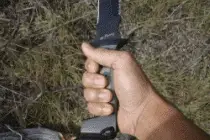
The handle on survival knives varies widely. Some are hard rubber, others polymer. Many are good and it is probably easiest to remember what you should avoid; Any knife that has a hollow handle for “storing things.”  While this sounds neat at first there are a couple of good reasons to avoid knives like this.
Mel Perry Knife
The Parry Blade Survival Knife
  1. If it has a hollow handle the knife certainly doesn’t have a full tang, which we mentioned earlier was important.
  2. If you are storing matches in your knife handle, and you lose the knife guess what else is gone…?
Another thing to avoid that is popular among novelty survival knives is a compass in the handle. Again, seems like a cool feature, but it could mess up your grip on the knife. Is it really worth having a 25 cent compass in the handle of one of your most important tools when there is a chance it will make the knife hard to work with or even injure you? In a survival situation that is unacceptable.

3.  Blade (Metal)

Carbon Blade
Carbon Blade on the Mora 711
Survival Knives generally come in two types of steel: Stainless or Carbon. Which is better is a huge debate and I won’t recommend which one you should choose but here are the main differences.
  • Stainless Steel is…well it’s stainless steel. Virtually indestructible, can take a beating and last a long time without rusting. However many people say stainless blades lose an edge faster than carbon.
  • Carbon Steel knives are usually known to hold a good edge longer than stainless steel, but will rust faster in the elements.

4.  Blade (Design)

Fallkniven F1, SOG Seal Pup Elite, and KJ Eriksson Mora Carbon Knife 711
Again this one comes down to a debate over which is better; straight blade or serrated. A straight blade knife will work better for chopping wood and is much easier to sharpen. A good smooth stone can even be used to sharpen a straight blade if you are without a whetstone, whereas a serrated edge almost always takes a special sharpener.

5. Blade (Length)

Mel Perry Knife SAS
The Parry Blade
Most Survival Knives fall within the range of 6 to 12 inches. Any less and it might not be big enough to do the things you will have to get done in a survival situation, like chopping wood. Sure, it would work a lot better with a hatchet or saw, but if you Bug Out, you might not have anything else.
However, start getting much bigger than 9 to 10 inches and you start getting Rambo syndrome. This is the point where the knife is getting too big to handle and carry effectively and might be more of hindrance than a tool.

6. Blade (Thickness)

Knife Blade Thickness
Huge Differences in Blade Thickness
This is a harder one for those of us who are not knife experts. A good general rule is about 3/16 -4/16 of an inch thickness is the best for survival knives. A knife of that thickness will be extremely solid and and able withstand the abuse of wood chopping and prying. You do not want a survival knife that has a lot of flex in the blade.

7. Sheath

Knife Sheath
The SOG here is probably best: Lower Attachment, Lanyard, and Lower Strap
If you aren’t familiar with serious survival knives the sheath of your knife can seem less than important, however the sheath will affect a lot about how you carry and draw your knife. There are really three things you want in your ideal sheath:
  1. Lower Attachment – Some type of hole or attachment piece at the tip end of the sheath used for strapping the knife to your leg when on the belt, or onto a backpack strap.
  2. Belt and Lanyard Attachment: Does the sheath come with a belt loop? Does the knife handle itself have a hole for a lanyard?
  3. Strap: How does the sheath close around the knife? A crossover strap right where the handle meets the sheath is best. Sheath’s with the strap at the base of the handle can allow the knife to slide out.
Keep These 7 Things in mind when you buy your next survival knife.

Friday, November 8, 2013

Basics of a First Aid Kit


Preparing a First Aid kit for your family is one of the best things you can do when thinking about their health and safety. The only thing you really need to know is what to include inside to be prepared for all kinds of situations, ranging from minor cuts and burns to more serious injuries that can be maintained before the emergency services arrive.
For a basic first aid kit, you will need the following things:
1. A First Aid manual -  While in a stressful, urgent situation you may not want to spend any time flicking through a manual, but it could be the most important item in your kit. Everyone develops first aid knowledge throughout their lives, so chances are you will have a basic idea of what to do when the time comes. Stressful situations can do funny things, causing you to forget the most basic things. Having a manual on hand is a great way to remind yourself of key steps to get you back on track. To develop your skills even further, consider taking a First Aid course; there are many places available in every city so they are always very accessible.
2. Bandages – An obviously important one, have a variety of bandages on hand, different sizes, lengths and shapes for a variety of injuries.
3. Gauze pads – These are another essential as they help to stop bleeding. Make sure to include scissors to cut them and bandages to size.
4. Antiseptic cream -  This is important when dressing a wound as you want to keep it as clean as possible to avoid any infection.
5.  A cold compress is perfect for bumps and bruises that are common with young kids who tend to fall and run into everything. Reduce the pain and swelling by applying some pressure with a cold compress.
6. Aspirin/Paracetamol -  Any kind of basic painkiller is a must have in any First Aid kit, from headaches to muscle pains, they are the cure to all ailments.
7. Tweezers – One of the most common reasons for treating in First Aid is splinter removal. Simple enough injury, but painful none the less, and can end up being a real hassle if you don’t have the right tools to treat it.
There are many other things you can include in your First Aid kit, including a blanket, thermometer, whistle or other medications like antihistamines; you will need to consider where you will use the First Aid kit most often and the types of injuries you will expect to be treating.

Tuesday, November 5, 2013

STUDY: THERE ARE 8.8 BILLION EARTH-SIZE, JUST-RIGHT PLANETS - JUST IN OUR GALAXY!

WASHINGTON (AP) — Space is vast, but it may not be so lonely after all: A study finds the Milky Way is teeming with billions of planets that are about the size of Earth, orbit stars just like our sun, and exist in the Goldilocks zone – not too hot and not too cold for life.
Astronomers using NASA data have calculated for the first time that in our galaxy alone, there are at least 8.8 billion stars with Earth-size planets in the habitable temperature zone.
The study was published Monday in the journal Proceedings of the National Academy of Science.
Study: 8.8 Billion Earth Size, Just Right Planets
This artist’s rendition provided by NASA shows Kepler-69c, a super-Earth-size planet in the habitable zone of a star like our sun, located about 2,700 light-years from Earth in the constellation Cygnus. AP Photo/NASA/Ames/JPL-Caltech)
For perspective, that’s more Earth-like planets than there are people on Earth.
As for what it says about the odds that there is life somewhere out there, it means “just in our Milky Way galaxy alone, that’s 8.8 billion throws of the biological dice,” said study co-author Geoff Marcy, a longtime planet hunter from the University of California at Berkeley.
The next step, scientists say, is to look for atmospheres on these planets with powerful space telescopes that have yet to be launched. That would yield further clues to whether any of these planets do, in fact, harbor life.
The findings also raise a blaring question, Marcy said: If we aren’t alone, why is “there a deafening silence in our Milky Way galaxy from advanced civilizations?”
In the Milky Way, about 1 in 5 stars that are like our sun in size, color and age have planets that are roughly Earth’s size and are in the habitable zone where life-crucial water can be liquid, according to intricate calculations based on four years of observations from NASA’s now-crippled Kepler telescope.
Kepler scientist Natalie Batalha said there is still more data to pore over before this can be considered a final figure.

There are about 200 billion stars in our galaxy, with 40 billion of them like our sun, Marcy said. One of his co-authors put the number of sun-like stars closer to 50 billion, meaning there would be at least 11 billion planets like ours.

Based on the 1-in-5 estimate, the closest Earth-size planet that is in the habitable temperature zone and circles a sun-like star is probably within 70 trillion miles of Earth, Marcy said.

And the 8.8 billion Earth-size planets figure is only a start. That’s because scientists were looking only at sun-like stars, which are not the most common stars.
An earlier study found that 15 percent of the more common red dwarf stars have Earth-size planets that are close-in enough to be in the not-too-hot, not-too-cold Goldilocks Zone.
Put those together and that’s probably 40 billion right-size, right-place planets, Marcy said.
And that’s just our galaxy. There are billions of other galaxies.
Scientists at a Kepler science conference Monday said they have found 833 new candidate planets with the space telescope, bringing the total of planets they’ve spotted to 3,538, but most aren’t candidates for life.
Kepler has identified only 10 planets that are about Earth’s size circling sun-like stars and are in the habitable zone, including one called Kepler 69-c.
Because there are probably hundreds of planets missed for every one found, the study did intricate extrapolations to come up with the 22 percent figure – a calculation that outside scientists say is fair.
“Everything they’ve done looks legitimate,” said MIT astronomer Sara Seager.

Monday, November 4, 2013

How to Spot Animals in the Wild


Hiding BearViewing animals in the wild can be the highlight of any nature experience. I grew up in a Canadian park bordering Minnesota’s Boundary Waters Canoe Area. Here it was common to spot moose, bear, wolves and lynx, sometimes right in our own backyard (and once, in the hallway of our house). But you don’t have to live in the wilderness to spot wildlife. Wherever you live, you can increase the likelihood of seeing birds and mammals by remembering a few key tips:

Look for transition areas

wildlife_01Like humans, animals spend much of their time near food and water. Transition areas like estuaries, river banks and shorelines are good candidates for diverse wildlife viewing, because they allow access to food and water along with protection from potential predators. Animals like deer need open sunny areas where there is herbaceous growth and shrubs, but they also want to be close to a forested area for shelter. The soil, mud or sand next to a waterway is also a good place to observe animal tracks and learn about animal behavior, providing it hasn’t been disturbed by human feet. Other likely locations include south facing slopes in early spring (the fresh spring greens attract all manner of wildlife) and meadows near a forest’s edge.

Consider the time of day and year

Wilderness
While some animals are active at all times of day, many birds and mammals choose dawn or dusk to feed and travel. Watch any bird feeder or listen to the dawn symphony to see that breakfast begins as the sun rises. Deer and other ungulates are most active and easily spotted one or two hours around dawn and sunset. Animals also tend to be most active during mating season and when rearing their young. They may be easier to spot when feeding in open areas like meadows, fields, roadsides and waterways.

Know your target species

Wildlife
If you are looking to view a particular species of wildlife, learn about their habits and food supply. For example, don’t look for bears in winter. Instead, know when they come out of hibernation in your area and what food is available at that time. In our neck of the woods, bears emerge in March or April and head for the fresh spring growth in the local farmer’s fields. Driving down the highway on a sunny day in springtime, we can often spot two or three black bears feasting on new spring greens, or see them at the estuary nibbling on fresh seaweed and shellfish. Later in the summer, those same bears are deep in the forest eating berries and digging for grubs. When fall arrives, they are often fishing for salmon by the river’s edge. Knowing what local animals eat and where they travel is one way to increase your chances of finding them.

Watch for animal scat, trails, tracks, runways and other signs

Wildlife
Tracks and other signs of animal passage will tell you a lot about wildlife behavior. They may also increase your chances of spotting the real thing. Mammals like deer, moose, foxes, and elk often create runways through the underbrush that identify the areas where they travel. Aquatic mammals like beavers and otters leave telltale signs near the water’s edge, including scat, lodges, dens, dams, flattened muddy trails, chewed wood, and even—in the case of otters—water slides. After tracking a racoon for several hours one day, I learned that racoons, like humans, will take the path of least resistance through a forest. This includes walking across every fallen log within reach. You can increase your chances of spotting animal tracks, and often animals, by raking a sandy area next to a water source. Checking back usually reveals a highway of birds, rodents, and other mammals travelling to and fro. Raking a regular trail will help make the tracks more distinct and give a better idea of the track age. A general rule of thumb is that tracks are most easily spotted in areas covered by snow, mud, and sand.

Bring the right equipment

wildlife_05
A powerful pair of binoculars is a must-have for anyone interested in spotting wildlife up close. Not only do they protect you from potential encounters with large mammals, giving you the distance you need to stay safe, but they often allow you to observe wildlife unnoticed. Disturbed wildlife may be unable to feed or migrate safely, which may in turn disrupt their rate of survival. Keeping your distance while still getting an up-close look is one way to improve the experience for everyone. To improve the experience still further, I use a spotting scope (20x to 60x). Although heavy when hiking long distances, the scope is worth the effort when viewing of marine mammals like sea lions and whales from shore or watching far-off birds or wildlife interact and rear its young. A zoom lens on a digital camera is also great, but a trail cam that can take time-lapsed photos and has motion sensor trigger is a far more useful tool. If available, this tool can help you identify what kind of wildlife is using an area and when, so that you can focus your limited time more effectively. It will capture images that you could never get safely in person.

Stay still or move slowly and quietly

Deer
Humans are large and smelly enough that most wildlife knows we are coming before we even get close to viewing them. One way around this is to get comfortable in a wildlife viewing area before dawn or dusk and sit patiently and quietly until they arrive. You can also climb a tree, mount a tree-sit, or hide yourself in shrubbery with the aid of camouflage (but not during hunting season!) or behind a hunting or viewing blind. Make sure you are downwind of your quarry and avoid bringing pets that might disturb wildlife by barking or running. However, a well-trained canine can alert you to wildlife long before you would suspect their presence. If you do need to move when wildlife are present, do so from a distance, walking slowly and quietly. Watch the ground for branches or other debris that might alert them to your presence if stepped on. If you can, try spotting wildlife from a canoe or kayak: nothing is quite as stealthy as water travel.

Listen to the other wildlife in the area

Bird
Wild animals interact daily, often with dramatic results. Over the years I’ve learned that a loud ruckus of crows or robins usually means a bird of prey is in the vicinity. Both robins and crows will mob owls on the hunt. Ravens and seagulls will do the same to eagles, who just might be relieved of any meat they are carrying. In a similar way, birdsong and bird behavior will often change if predators like hawks are in the area, warning other birds to scatter or protect one another who share the same flock mentality. Frogs go silent when something approaches, so try paying attention to the changes around you.

Practice your animal and bird calls

Making wildlife calls may be an art, but practice will increase your chances of sounding like the animal in question. My father taught me calls for owls, loons, and song birds, which can be made simply by framing two hands over the mouth in various positions. For a simpler bird call, try summoning owls and hawks or mink by making rodent sounds (like squeaks) with puckered lips. A good way to learn bird and animal calls is to listen to recordings (and the real thing). Identification is the first step towards mimicking.
Whatever strategies you use to increase your chances of spotting wildlife, remember that maintaining your distance and avoiding contact is an important way to ensure wildlife remains in its natural state. If wildlife is constantly disturbed, their ability to thrive will be in question. More learning and enjoyment comes from watching from a distance rather than seeing how close you can get. It is also essential not to feed wildlife or leave waste out where they can become habituated to humans. As the saying goes, “A fed bear is a dead bear.” The same goes for other species.

Friday, November 1, 2013

29 Incredible Facts Which Prove That Poverty In America Is Absolutely Exploding

Did you know that the number of Americans on welfare is higher than the number of Americans that have full-time jobs?  Did you know that 1.2 million public school students in the U.S. are currently homeless?  Anyone that uses the term "economic recovery" to describe what is happening in the United States today is being deeply insulting to the nearly 150 million Americans that are considered to be either "poor" or "low income" at this point.  Yes, things are great in New York City, Washington D.C. and San Francisco, but almost everywhere else economic conditions continue to steadily get worse.  The gap between the wealthy and the poor is at a level that America has never seen before, and this is beginning to create a "Robin Hood mentality" that could cause a tremendous amount of social chaos in the years ahead.  Anger at the "haves" in America continues to rise at a very alarming pace, and the "have nots" are becoming increasingly desperate.   

Despite unprecedented borrowing by the federal government in recent years, and despite unprecedented money printing by the Federal Reserve, poverty in the United States keeps getting worse with each passing year. The following are 29 incredible facts which prove that poverty in America is absolutely exploding...
1. What can you say about a nation that has more people getting handouts from the federal government than working full-time?  According to the latest numbers from the U.S. Census Bureau, the number of people receiving means-tested welfare benefits is greater than the number of full-time workers in the United States.
2. New numbers have just been released, and they show that the number of public school students in this country that are homeless is at an all-time record high.  It is hard to believe, but right now 1.2 million students that attend public schools in America are homeless.  That number has risen by 72 percent since the start of the last recession.
3. When I was growing up, it seemed like almost everyone was from a middle class home.  But now that has all changed.  One recent study discovered that nearly half of all public students in the United States come from low income homes.
4. How can anyone deny that we are a socialist nation when half the people are getting money from the federal government each month?  According to the most recent numbers from the U.S. Census Bureau, 49.2 percent of all Americans are receiving benefits from at least one government program.
5. Signs of increasing poverty are even showing up in the wealthiest areas of the nation.  According to the New York Post, New York subways are being "overrun with homeless".
6. According to the U.S. Census Bureau, approximately one out of every six Americans is now living in poverty.  The number of Americans living in poverty is now at a level not seen since the 1960s.
7. The gap between the rich and the poor in the United States is at an all-time record high.  The wealthy may not consider this to be much of a problem, but those at the other end of the spectrum are very aware of this.
8. The "working poor" is one of the fastest growing segments of the U.S. population.  At this point, approximately one out of every four part-time workers in America is living below the poverty line.
9. According to numbers provided by Wal-Mart, more than half of their hourly workers make less than $25,000 a year.
10. A recent Businessweek article mentioned a study that discovered that 300 employees at one Wal-Mart in Wisconsin receive a combined total of nearly a million dollars a year in public assistance...
“A decent wage is their demand—a livable wage, of all things,” said Representative George Miller (D-Calif.). The problem with companies like Wal-Mart is their “unwillingness, not their inability, to pay that wage,” he said. “They hand off the difference to taxpayers.” Miller was referring to a congressional report(PDF) released in May that calculated how much Walmart workers rely on public assistance. The study found that the 300 employees at one Supercenter in Wisconsin required some $900,000 worth of public assistance a year.
11. The stock market may be doing great (for the moment), but incomes for average Americans continue to decline.  In fact, median household income in the United States has fallen for five years in a row.
12. The quality of the jobs in America has been steadily dropping for years.  At this point, one out of every four American workers has a job that pays $10 an hour or less.
13. According to a Gallup poll that was recently released, 20.0% of all Americans did not have enough money to buy food that they or their families needed at some point over the past year.  That is just under the record of 20.4% that was set back in November 2008.
14. Young adults are particularly feeling the sting of poverty these days.  American families that have a head of household that is under the age of 30 have a poverty rate of 37 percent.
15. As I wrote about a few weeks ago, one out of every fivehouseholds in the United States is on food stamps.  Back in the 1970s, about one out of every 50 Americans was on food stamps.
16. The number of Americans on food stamps now exceeds the entire population of Spain.
17. According to one calculation, the number of Americans on food stamps now exceeds the combined populations of "Alaska, Arkansas, Connecticut, Delaware, District of Columbia, Hawaii, Idaho, Iowa, Kansas, Maine, Mississippi, Montana, Nebraska, Nevada, New Hampshire, New Mexico, North Dakota, Oklahoma, Oregon, Rhode Island, South Dakota, Utah, Vermont, West Virginia, and Wyoming."
18. We are told that we live in the "wealthiest nation" on the planet, and yet more than one out of every four children in the United States is enrolled in the food stamp program.
19. The average food stamp benefit breaks down to approximately $4 per person per day.
20. It is being projected that approximately 50 percent of all U.S. children will be on food stamps before they reach the age of 18.
21. Today, approximately 17 million children in the United States are facing food insecurity.  In other words, that means that "one in four children in the country is living without consistent access to enough nutritious food to live a healthy life."
22. It may be hard to believe, but approximately 57 percent of all children in the United States are currently living in homes that are considered to be either "low income" or impoverished.
23. The number of children living on $2.00 a day or less in the United States has grown to 2.8 million.  That number has increased by 130 percent since 1996.
24. In Miami, 45 percent of all children are living in poverty.
25. In Cleveland, more than 50 percent of all children are living in poverty.
26. According to a recently released report, 60 percent of all children in the city of Detroit are living in poverty.
27. According to a Feeding America hunger study, more than 37 million Americans are now being served by food pantries and soup kitchens.
28. The U.S. government has spent an astounding 3.7 trillion dollars on welfare programs over the past five years.
29. It has been reported that 4 out of every 5 adults in the United States "struggle with joblessness, near-poverty or reliance on welfare for at least parts of their lives".
These poverty numbers keep getting worse year after year no matter what our politicians do.
So is there anyone out there that would still like to argue that we are in an "economic recovery"?
And as I mentioned above, the "have nots" are becoming increasingly angry at the "haves".  For example, just check out the following excerpt from a recent New York Post article...
The maniac who butchered a Brooklyn mom and her four young kids confessed that he did it because he was jealous of their way of life, a police source told The Post on Sunday.
The family had too much. Their income (and) lifestyle was better than his,” the source said.
The bloody suspect was caught holding the kitchen knife he used during the Saturday night rampage inside the Sunset Park apartment where he had been staying with the victims, the source added.
Sadly, this was not an isolated incident.  All over the western world, a "Robin Hood mentality" is growing.  This is something that I am so concerned about that I made it a big part of my new book.  At this point, even wealthy Hollywood-types such as actor Russell Brand are calling for a socialist-style "revolution" and a "massive redistribution of wealth".
Perhaps Brand does not understand that what he is calling for would mean redistributing most of his own wealth away from him.
When the next major wave of the economic collapse strikes, I fear that all of this anger and frustration that are growing among the poor will boil over in some very frightening ways.  I believe that we will see a huge spike in crime and that we will eventually see communities all over America looted and burning.
But I am not the only one that is thinking along these lines.  A new National Geographic Channel movie entitled "American Blackout" attempts to portray the social chaos that could erupt in the event of an extended national power failure...
American Blackout, National Geographic Channel’s two-hour, edge-of-your-seat movie event imagines the story of a national power failure in the United States caused by a cyberattack — told in real time, over 10 days, by those who kept filming on cameras and phones. You’ll learn what it means to be absolutely powerless.
Don't ignore what is happening in America right now.  It is setting the stage for some very chaotic times.
Get ready while you still can.