Why?

This blog is to help you in preparing for an emergency. It also contains other information that you might find spiritually up-lifting. This is not an official website of "The Church of Jesus Christ of Latter-day Saints". This site is maintained by Barry McCann (barry@mail.com)

Friday, July 17, 2015

The Bankruptcy Of The Planet Accelerates – 24 Nations Are Currently Facing A Debt Crisis

There has been so much attention on Greece in recent weeks, but the truth is that Greece represents only a very tiny fraction of an unprecedented global debt bomb which threatens to explode at any moment.  As you are about to see, there are 24 nations that are currently facing a full-blown debt crisis, and there are 14 more that are rapidly heading toward one.  Right now, the debt to GDP ratio for the entire planet is up to an all-time record high of 286 percent, and globally there is approximately 200 TRILLION dollars of debt on the books.  That breaks down to about $28,000 of debt for every man, woman and child on the entire planet.  And since close to half of the population of the world lives on less than 10 dollars a day, there is no way that all of this debt can ever be repaid.  The only “solution” under our current system is to kick the can down the road for as long as we can until this colossal debt pyramid finally collapses in upon itself.
As we are seeing in Greece, you can eventually accumulate so much debt that there is literally no way out.  The other European nations are attempting to find a way to give Greece a third bailout, but that is like paying one credit card with another credit card because virtually everyone in Europe is absolutely drowning in debt.
Even if some “permanent solution” could be crafted for Greece, that would only solve a very small fraction of the overall problem that we are facing.  The nations of the world have never been in this much debt before, and it gets worse with each passing day.
According to a new report from the Jubilee Debt Campaign, there are currently 24 countries in the world that are facing a full-blown debt crisis
■ Armenia
■ Belize
■ Costa Rica
■ Croatia
■ Cyprus
■ Dominican Republic
■ El Salvador
■ The Gambia
■ Greece
■ Grenada
■ Ireland
■ Jamaica
■ Lebanon
■ Macedonia
■ Marshall Islands
■ Montenegro
■ Portugal
■ Spain
■ Sri Lanka
■ St Vincent and the Grenadines
■ Tunisia
■ Ukraine
■ Sudan
■ Zimbabwe
And there are another 14 nations that are right on the verge of one…
■ Bhutan
■ Cape Verde
■ Dominica
■ Ethiopia
■ Ghana
■ Laos
■ Mauritania
■ Mongolia
■ Mozambique
■ Samoa
■ Sao Tome e Principe
■ Senegal
■ Tanzania
■ Uganda
So what should be done about this?
Should we have the “wealthy” countries bail all of them out?
Well, the truth is that the “wealthy” countries are some of the biggest debt offenders of all.  Just consider the United States.  Our national debt has more than doubled since 2007, and at this point it has gotten so large that it is mathematically impossible to pay it off.
Europe is in similar shape.  Members of the eurozone are trying to cobble together a “bailout package” for Greece, but the truth is that most of them will soon need bailouts too
All of those countries will come knocking asking for help at some point. The fact is that their Debt to GDP levels have soared since the EU nearly collapsed in 2012.Spain’s Debt to GDP has risen from 69% to 98%. Italy’s Debt to GDP has risen from 116% to 132%. France’s has risen from 85% to 95%.
In addition to Spain, Italy and France, let us not forget Belgium (106 percent debt to GDP), Ireland (109 debt to GDP) and Portugal (130 debt to GDP).
Once all of these dominoes start falling, the consequences for our massively overleveraged global financial system will be absolutely catastrophic
Spain has over $1.0 trillion in debt outstanding… and Italy has €2.6 trillion. These bonds are backstopping tens of trillions of Euros’ worth of derivatives trades. A haircut or debt forgiveness for them would trigger systemic failure in Europe. EU banks as a whole are leveraged at 26-to-1. At these leverage levels, even a 4% drop in asset prices wipes out ALL of your capitalAnd any haircut of Greek, Spanish, Italian and French debt would be a lot more than 4%.
Things in Asia look quite ominous as well.
According to Bloomberg, debt levels in China have risen to levels never recorded before…
While China’s economic expansion beat analysts’ forecasts in the second quarter, the country’s debt levels increased at an even faster pace. Outstanding loans for companies and households stood at a record 207 percent of gross domestic product at the end of June, up from 125 percent in 2008, data compiled by Bloomberg show.
And remember, that doesn’t even include government debt.  When you throw all forms of debt into the mix, the overall debt to GDP number for China is rapidly approaching 300 percent.
In Japan, things are even worse.  The government debt to GDP ratio in Japan is now up to an astounding 230 percent.  That number has gotten so high that it is hard to believe that it could possibly be true.  At some point an implosion is coming in Japan which is going to shock the world.
Of course the same thing could be said about the entire planet.  Yes, national governments and central banks have been attempting to kick the can down the road for as long as possible, but everyone knows that this is not going to end well.
And when things do really start falling apart, it will be unlike anything that we have ever seen before.  Just consider what Egon von Greyerz recently told King World News
Eric, there are now more problem areas in the world, rather than stable situations. No major nation in the West can repay its debts. The same is true for Japan and most of the emerging markets. Europe is a failed experiment for socialism and deficit spending. China is a massive bubble, in terms of its stock markets, property markets and shadow banking system. Japan is also a basket case and the U.S. is the most indebted country in the world and has lived above its means for over 50 years. So we will see twin $200 trillion debt and $1.5 quadrillion derivatives implosions. That will lead to the most historic wealth destruction ever in global stock, with bond and property markets declining at least 75 – 95 percent. World trade will also contract dramatically and we will see massive hardship across the globe.

Tuesday, July 14, 2015

A report set to be released on July 15 shows that concealed carry permits have surged since 2007, while at the same time murders and violent crime have decreased by “25 percent.”

The study was conducted by the Crime Prevention Research Center (CPRC).

According the The Washington Times, the CPRC study shows the number of concealed carry permits increased “from 4.6 million [in 2007] to over 12.8 million” now. And the number of permits sought increases with each passing year.
For example, “over 1.7 million new permits were issued [in 2014],” which represents a “15.4 percent increase” over the number issued the year before.  The CPRC report also shows that concealed carry permits are no longer just a guy thing, either. Rather, since 2007 “permits for women have increased by 270 percent” while permits for men have increased “by 156 percent.”
Throughout this surge in concealed carry permitting, murder and violent crime rates have fallen. The rate for murder fell from “5.6 to 4.2 per 100,000, about a 25 percent drop.” Violent crime fell “25 percent” as well.
National Shooting Sports Foundation senior vice president Larry Keene committed on the findings, saying:
It puts the lie to the myth promulgated by anti-gun individuals that somehow more law-abiding citizens carrying guns will lead to more crime. In fact, quite the opposite is the case.More law-abiding citizens own firearms for self-protection and crime continues to decline.
In December 2013 Breitbart News reported on a Congressional Research Service (CRS) study that showed a similar pattern based solely on gun ownership. The study showed that the number of privately owned guns in America went from 192 million firearms in 1994 to 310 million firearms in 2009, and crime fell sharply during that time.
The murder rate of 6.6 per 100,000 Americans in 1993 fell to 3.6 in 2000 and finally as low as 3.2 in 2011.

By 2045 'The Top Species Will No Longer Be Humans,' And That Could Be A Problem ...THE SINGULARITY APPROACHES


Terminator
terminator red eye rise of robots"Today there's no legislation regarding how much intelligence a machine can have, how interconnected it can be. If that continues, look at the exponential trend. We will reach the singularity in the timeframe most experts predict. From that point on you're going to see that the top species will no longer be humans, but machines."
These are the words of Louis Del Monte, physicist, entrepreneur, and author of "The Artificial Intelligence Revolution." Del Monte spoke to us over the phone about his thoughts surrounding artificial intelligence and the singularity, an indeterminate point in the future when machine intelligence will outmatch not only your own intelligence, but the world's combined human intelligence too.
The average estimate for when this will happen is 2040, though Del Monte says it might be as late as 2045. Either way, it's a timeframe of within three decades.
louis del monte
Screenshot
Louis Del Monte.
"It won't be the 'Terminator' scenario, not a war," said Del Monte. "In the early part of the post-singularity world, one scenario is that the machines will seek to turn humans into cyborgs. This is nearly happening now, replacing faulty limbs with artificial parts. We'll see the machines as a useful tool. Productivity in business based on automation will be increased dramatically in various countries. In China it doubled, just based on GDP per employee due to use of machines."
"By the end of this century," he continued, "most of the human race will have become cyborgs [part human, part tech or machine]. The allure will be immortality. Machines will make breakthroughs in medical technology, most of the human race will have more leisure time, and we'll think we've never had it better. The concern I'm raising is that the machines will view us as an unpredictable and dangerous species."
Del Monte believes machines will become self-conscious and have the capabilities to protect themselves. They "might view us the same way we view harmful insects." Humans are a species that "is unstable, creates wars, has weapons to wipe out the world twice over, and makes computer viruses." Hardly an appealing roommate.
He wrote the book as "a warning." Artificial intelligence is becoming more and more capable, and we're adopting it as quickly as it appears. A pacemaker operation is "quite routine," he said, but "it uses sensors and AI to regulate your heart."
A 2009 experiment showed that robots can develop the ability to lie to each other. Run at the Laboratory of Intelligent Systems in the Ecole Polytechnique Fédérale of Lausanne, Switzerland, the experiment had robots designed to cooperate in finding beneficial resources like energy and avoiding the hazardous ones. Shockingly, the robots learned to lie to each other in an attempt to hoard the beneficial resources for themselves.
"The implication is that they're also learning self-preservation," Del Monte told us. "Whether or not they're conscious is a moot point."

Monday, July 13, 2015

Sunday, July 12, 2015

Tactical Pen: Mightier Than The Sword

Sometimes carrying a knife or a firearm just isn’t an option…

But that doesn’t mean you should be left defenseless.

You have other options

How would you like to carry with you something that is 100% legal everywhere yet can be deployed as a less-lethal (and perhaps deadly force or lethal) weapon if you know how to use it?

Imagine an icepick that can write!

The Tactical Pen is the answer.

I have carried one of these devices for years, and have never had one taken from me even after passing through many security screening areas at airports, courthouses, etc.
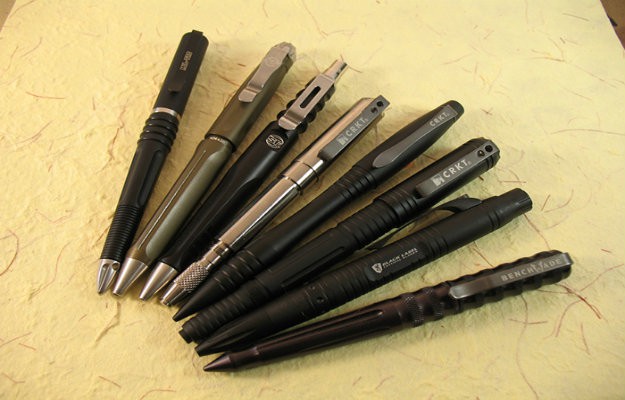
types of tactical pens
Many types of tactical pens exist…

Tactical Pen Review

So you ask why is a pen a useful self-defense option? The answer is that is you know how to use the pen to trigger and attack pressure points and weak areas on the human body then the pen can be highly useful to someone defending himself or herself.
The tactical pen, which is designed to not break during combat, can also be used to strike sensitive areas of the human anatomy that could cause great bodily harm or death. Those deadly force targets, such as the eyes, throat, and groin would only be justified to strike if a person was in fear for his or her life and felt the need to use deadly force as an appropriate response to the attack presented. That being said the Tactical Pen must be thought of as both a less-lethal and a potentially lethal weapon. That versatility and its covert appearance are major reasons to own and carry one of these devices.
There are courses and some videos that can help you prepare yourself to use the Tactical Pen. Any of these can be helpful to the person wanting to become proficient in the use of this weapon as with any weapon. A competent martial arts or combatives instructor might also be able to provide you with the proper training.
So where can you get one of these Tactical Pens? There are many sources but you can get one of these pens through the survivallife.com website and an entire course on how to use it, right here:
I hope that each of you will consider buying and carrying a Tactical Pen due to the fact that it is a small, covert weapon, which is inexpensive and can save your life when attacked. Plus, who cannot always use another pen?

Saturday, July 11, 2015

In 1 in 5 Families in U.S., No One Works...

In 19.9 percent of American families in 2014, according to data released by the Bureau of Labor Statistics (BLS), no one in the family worked.
A family, as defined by the BLS, is a “group of two or more persons residing together who are related by birth, marriage, or adoption.  In 2014, there were 80,889,000 families in the United States,  and in 16,057,000 of those families, or 19.9 percent, no one had a job.
not working
The BLS designates a person as “employed” if “during the survey reference week” they “(a) did any work at all as paid employees; (b) worked in their own business, profession, or on their own farm; (c) or worked 15 hours or more as unpaid workers in an enterprise operated by a member of the family.”
Members of the 16,057,000 families in which no one held jobs could have been either unemployed or not in the labor force. The BLS designates a person as unemployed if they did not have a job but were actively seeking one. The BLS designates someone as not in the labor force, if they did not have a job and were not actively seeking one.
The BLS has been tracking data on employment in families since 1995. That year, the percent of families in which no one had a job was 18.8 percent. The percentage hit an all-time high of 20.2 percent in 2011. It held steady at 20 percent in 2012 and 2013. In 2014, it declined to 19.9 percent.
Barack Obama and Joe Biden
You write the caption on these two...
The BLS also calculates these data for single-parent families. In 25.6 percent of families maintained by women with no spouse present, no family member is employed. In 17 percent of families maintained by men with no spouse present, no family member is employed.
The data on employment in families is based on the Census Bureau’s Current Population Survey of the civilian non-institutional population, which includes people 16 and older, who are not on active duty in the military or in an institution such as a prison, nursing home or mental hospital.

Friday, July 10, 2015

The world is drowning in debt, warns Goldman Sachs

Aging populations mean countries' debt piles risk growing out of control, warns European head of Goldman Sachs Asset Management

The world is sinking under too much debt and an ageing global population means countries' debt piles are in danger of growing out of control, the European chief executive of Goldman Sachs Asset Management has warned. 
Andrew Wilson, head of Europe, Middle East and Africa (EMEA), said growing debt piles around the world posed one of the biggest threats to the global economy. 
"There is too much debt and this represents a risk to economies. Consequently, there is a clear need to generate growth to work that debt off but, as demographics change, new ways of thinking at a policy level are required to do this," he said. 
"The demographics in most major economies – including the US, in Europe and Japan - are a major issue – and present us with the question of how we are going to pay down the huge debt burden. With life expectancy increasing rapidly, we no longer have the young, working populations required to sustain a debt-driven economic model in the same way as we've managed to do in the past." 
Mr Wilson used Japan, where gross government debt has climbed above 200pc of gross domestic product (GDP), as an example of where the ageing population could demographics were working against them. "[This] is evidently not sustainable over the long term," he said. 
The Organisation of Economic Co-operation and Development (OECD) has also sounded out a warning about Japan's growing debt pile. The Paris-based think-tank said gross government debt was on course to balloon to more than 400pc by 2040 if the government did not carry out reforms. 
Angel Gurria, the OECD's secretary-general, said monetary stimulus and stronger growth alone would not be enough to haul the economy out of its two-decade malaise. 
"Japan's future prospects depend on ensuring fiscal sustainability over the long term. With a budget deficit of around 8pc of GDP, the debt ratio is set to rise further into uncharted territory," he said. 
Others have warned privately that Japan's debt mountain is unsustainable. "The crunch point is when it starts to run a current account deficit," said one senior banker. "When they stop running a current account surplus and they need our money to survive, we're not going to lend to them at 30 or 40 basis points." 
Mr Wilson said there was hope for countries with high debt burdens. "The demographic shift means that we need to look to more creative policy, including immigration and workforce expansion in order to find ways to pay down debt. 
This is happening in Japan in the form of [prime minister] Shinzo Abe's drive to increase female labour participation and via efforts to boost inflation." 
The Goldman chief also said that warnings about liquidity shortages in the market were being "overplayed", especially with regards to the corporate bond market. He also said that bouts of volatility when the US Federal Reserve starts to raise interest rates were to be be expected. 
High profile executives including Jamie Dimon, the head of JP Morgan, and Tim Adams, the head of the Institute of International Finance have warned that the raft of regulation introduced in the wake of the 2008 crisis could potentially cause huge volatility in the markets. 
While Mr Wilson said the European Central Bank's €60bn a month bond-buying progamme meant it was hard to judge how liquid the market was, he added: "We should expect some growth in volatility - but I do not view that as a negative. In fact, I would view this as getting back to a more normal world. Moving out of an environment where there is a huge amount of government and central bank policy designed to provide certainty and liquidity and to dampen volatility is a healthy sign, not an unhealthy one."

Thursday, July 9, 2015

Practical Tips and Advice on Flood Protection & Recovery

floodsWhat are the floods?
The flood is a situation in which the overwhelming quantity of water accumulates on a dry land. There are different types of floods, and they are different in term of their destructiveness and the damage they cause. Still, each flood means a total submerging of households over a long period of time.
Forecast
The past few years have shown all the terror the floods can cause in the US. It is enough to remember the destruction of New Orleans during the hurricane Katrina and the flood of the coastal parts of New Jersey a few years later, to get the idea how dangerous this occurrence can be. In the following years, due to the climate changes, the probability of such events increases even more.
How severe is the damage?
The New Orleans is but a shade of what it once was. The floods completely destroyed thousands of homes, and killed hundreds of people. The city of New Jersey got a bit of a better deal, as the human casualties were greatly reduced, but the damage was still huge. In this case the flood insurance system was applied better, but the terrain configuration also played an important part.
Protection and Prevention of Floods
The key for the proper defense against these occurrences is prevention and protection.
  • Business Flood Protection – a package that provides advice through maps and easy to follow steps which will help you minimize the impact of floods on your business.
  • Community Flood Protection – this package is customized for each specific area and helps in preventing the loss of lives and damage made to the specific community.
  • Infrastructure Flood Protection – this package covers the risk assessment and flood maps to secure your business infrastructure.
  • Home Flood Protection – a highly customizable package that will help you protect your household and the property in it. We also provide insurable systems for flood control.
  • Grants for Repairs and Renewal – a service that includes grants of up to $7600 for homes and businesses affected by floods.
  • Emergency Equipment – this package consists of the gear required for quick response in both protection and damage control.
Flood can be undone!
Although it may seem impossible, you can remedy the situation after huge floods if you follow all the steps for drying process. The first and the most important thing is to know what type of flood you were affected by. There are 3 different types of floods:
  • Flash floods – they are the most dangerous as the entire process is fast and the flood hits in terms of minutes. The speed of the occurrence makes it hard to respond in time to prevent the damage.
  • Rapid onset floods – by the level of destruction they are similar to the previous type, but they develop longer, leaving people some time to react.
  • Slow on set floods – they are typical for places near big bodies of water. They develop slowly, and last up to several months. They mostly affect crops and livestock, and can cause outbreaks of diseases.
The drying process
The drying process is crucial in minimizing the effects of floods. It is not the best idea to tackle this problem on your own, as it requires trained professionals in order to avoid permanent damage to the objects. The reaction speed is essential. The FEMA has issued several instructions on how to act in such situations.
Handling the Emotions
Floods always provoke strong reactions, and it is of an utmost importance to maintain emotional balance. To avoid getting carried away by the situation, it is advised to look for some professional help and guidance. Some of the places you can find help in overcoming the emotional outbreak are:
  • Local flood control services
  • Local counselors and volunteers
  • Local parishes
  • The police
  • Red Cross representatives
  • Fire department
  • National Guard
  • Army and Navy
  • FEMA
The flood insurance
In case you have flood insurance, you will need to contact the insurance agency as soon as possible and start the collection process.
Things to remember:
  • Start cleanup process immediately,
  • Additional payments covered by insurance company (if any),
  • Save proofs for coverage (bills and receipts),
  • Prepare for possible floods in the future,
  • Document the conversations with your agent.
What if you are not insured?
This is a rather difficult situation and you will most probably have to depend on the help provided by local authorities and international humanitarian organizations. The recovery process is expensive and can cause some serious financial problems. In the worst case scenario, you would have to do all things by your own. In that case, it is essential to plan. The proper recovery process should be carried out in several steps:
  • Estimate the damage
  • Determine priorities
  • Security assessment
  • Mark the water levels
  • Remove carpets and rugs
  • Remove valuable items
  • Dispose

Tuesday, July 7, 2015

Headlines

Gas and food surge sends May prices on a tear


U.S. producer prices in May recorded their biggest increase in more than 2-1/2 years as the cost of gasoline and food rose, suggesting that an oil-driven downward drift in prices was nearing an end.
The Labor Department said on Friday its producer price index for final demand increased 0.5 percent last month, the largest gain since September 2012. That followed a 0.4 percent decline in April. 
In the year to May, the PPI fell 1.1 percent, marking the fourth straight 12-month decrease. Prices dropped 1.3 percent in the 12 months through April, the biggest fall since 2010. 
Economists had forecast the PPI rising 0.4 percent last month and falling 1.1 percent from a year ago. 
A sharp decline in crude oil prices since last year and a strong dollar have weighed on producer prices. While rising oil prices are easing some of the downward pressure on inflation, the upward trend in producer prices will be gradual because of the dollar's strength. 
The greenback has gained about 13.2 percent against the currencies of the United States' main trading partners since June 2014. 
The stabilization in producer prices should support views that the Federal Reserve will raise interest rates this year. 
Last month, gasoline prices surged 17 percent, the largest increase since August 2009. Food prices rose 0.8 percent in May, the biggest gain in just over a year, snapping five straight months of declines. 
Higher food prices were driven by a shortage of eggs after an outbreak of bird flu led to the culling of millions of chickens. Wholesale egg prices soared a record 56.4 percent last month. 
While the spillover from producer prices to consumer prices has weakened, higher gasoline and food prices are likely to feed into the May consumer price index. May consumer price data will be published next week. 
The volatile trade services component, which mostly reflects profit margins at retailers and wholesalers, increased 0.6 percent in May after falling 0.8 percent in the prior month. 
May's rise likely reflects improving profit margins at services station, which had been pressured by falling gasoline prices. 
A key measure of underlying producer price pressures that excludes food, energy and trade services dipped 0.1 percent last month after ticking up 0.1 percent in April. The so-called core PPI was up 0.6 percent in the 12 months through May.

Sunday, July 5, 2015

Sugar, flour, rice: panicked Greeks stock up on essentials

Athens (AFP) - Greeks were hoarding cash and food Saturday amid mounting fears the economy could collapse, cracking open their wallets only to stock up on essentials and stripping supermarket shelves in the process.
Mothers, elderly men and university students were spotted pushing heavily overloaded trolleys or coming out of shops weighed down by bags of food, with essentials such as sugar, flour and pasta top of the list.
In the well-off area of Glyfada in Athens residents appeared to have panicked, thrusting everything from vast rolls of toilet paper to multiple packs of lentils into their carts. 
"Most people are buying food now because they fear the worst," said Andreas Koutras, a 51-year old who works in finance, referring to a referendum Sunday on Greece's bailout which could seal its financial fate.
AFP photographs showed rows upon rows of empty shelves in supermarkets and shoppers said they were taking no chances, snapping up canned milk, chocolate and rice -- anything non-perishable that could be stored.
Middle-aged toy shop assistant Marilena, who was praying for customers on what is usually the busiest shopping day of the week, said her family was buying "food, only food, nothing else. Only what's necessary".
Prime Minister Alexis Tsipras has urged people to vote 'No', insisting that rejecting a bailout deal offered by the austerity-hit country's international creditors will put it in a stronger negotiating position.
His right-hand man, Finance Minister Yanis Varoufakis, has promised banks will re-open after the vote -- but with so much uncertainty surrounding Greece's future, many doubt him.
Nikos Archondis from the Panhellenic Exporters Association (PEA) told AFP "certain supermarkets are very concerned because they cannot forecast how the situation will evolve".
Stocks of meat, cheeses, fruits and vegetables "risk running low in the following weeks", he said.
- Run on medicines -
Reports that medicines were also flying off the shelves were supported by pharmacist Yannis Triantaphilou.
Priorities were "food and medicines" and he had seen "an increase of customers in the pharmacy".
Although the boost in business was welcome, Triantaphilou said if the banks did not re-open on Tuesday, "I don't know how we are going to work, if companies will provide medicines".
With anti-bailout 'No' voters tied neck and neck with the 'Yes' camp, fears a financial disaster may be brewing were compounded by frustration over the decision taken by many shops to refuse card payments.
With government-imposed capital controls capping ATM withdrawals at 60 euros ($67) per day, the number of banknotes in circulation has dropped dramatically, especially the smaller denominations.
Customers want to save their cash, but businesses are also desperate to get their hands on it.
Fortunately, "we have learned to live with less money," says Marilena, "because the last four to five years were very difficult for most of people."
"But we have needs, we adjust of course... but we cannot go any further," she said.
Like many Greeks, taxi driver Theodor Veletzas said he believed there was more at stake than a new deal, and the situation risked getting worse.
The referendum, he insisted, would effectively decide whether his country stayed in the eurozone or not. And he feared what would happen if the 'No' camp won.
"There are no banknotes in circulation. Shops are closed and people have no notes with which to buy food. I hope people will vote on Sunday to stay in Europe. We don't want another adventure", he said.

Saturday, July 4, 2015

Greece is on the brink of ruin as food and medicine run short and banks struggle to stay afloat.

Banks claimed they had €1bn of cash left to see them through the weekend, just €90 per head, and need immediate help from the European Central Bank.
Meanwhile, capital controls have led to staple foods, such as sugar and flour, to run short while pharmacies report they are fast running out of essential drugs.
Mary Papadopoulou, who runs a pharmacy in Plaka, told The Guardian that she had already run out of thyroid drug and would soon be out of others: “We have shortages. We’ve run out of thyroxine and unless things change dramatically we’ll be having a lot more shortages next week.”
The majority of Greece’s food supplies are imported, but the government’s ban on bank transfers means companies cannot pay their suppliers.
Vasilis Korkidis of the Confederation of Hellenic Commerce said: “Imports, exports, factories, firms, transport – everything is frozen. The only sectors in demand are food and fuel.” He added that the economy had lost €1.2bn in the past week alone.
“Even in the best-case scenario, it is going to take months to recover from the shock of closed banks and capital controls.
Now that they are in place, capital controls may last for a year.”
Tourist bookings are also down by 40 per cent, while an estimated 50,000 holidaymakers are cancelling visits to the country every day in a severe blow to one of the country’s biggest industries.
Greece defaulted in its €1.6bn debt payment to the IMF earlier this week, risking the biggest sovereign bankruptcy in history.
Tomorrow it will go to the polls in referendum to decide whether to adhere to the demands of the IMF, European Union and European Central Bank. The country’s radical Prime Minister, Alexis Tsipras, has urged the Greek people to vote ‘no’ in the hope it will force the country’s creditors to rethink their terms.
Addressing the nation, Tsipras said: “[Our creditors’] proposals, which clearly violate the European rules and the basic rights to work, equality and dignity show that the purpose of some of the partners and institutions was not a viable agreement for all parties, but possibly the humiliation of an entire people.
“But I personally pledge that I will respect the result of your democratic choice, whatever that may be.”
However, polls predict a close result and if banks do run out of money before the weekend it will likely lead people to vote ‘yes’ to end the misery. Tsipras has said he will resign if Greeks agree to the terms.