Why?

This blog is to help you in preparing for an emergency. It also contains other information that you might find spiritually up-lifting. This is not an official website of "The Church of Jesus Christ of Latter-day Saints". This site is maintained by Barry McCann (barry@mail.com)

Tuesday, March 25, 2014

A Simple Solar Oven Makes Salt Water Drinkable


It functions by filling the black boiler with salty sea water in the morning, then tightening the cap. As the temperature and pressure grows, steam is forced downwards through a connection pipe and collects in the lid, which acts as a condenser, turning the steam into fresh water. Once Diamanti established the fundamentals were sound, he experimented with a series of concepts for the aesthetic of the object.

“My goal was to design something friendly and recognizable for the users,” he explains. “The process developed quite naturally to determine the current shape; every detail is there for a reason, so the form, as well as production techniques, represent a compromise between technical and traditional.”

Primary field studies in sub-Saharan Africa revealed the habit of carrying goods on the head–also a common practice in other areas around the world–and this was integrated into Eliodomestico’s plan. And while solar stills aren’t a totally new concept, Diamanti says it’s rare to find them in a domestic context rather than in missions or hospitals, or as large plants overseen by qualified personnel that serve entire communities. “I tried to make something for a real household that could be operated directly by the families,” he says.

The project recently won a Core77 Design Award for Social Impact; already, Diamanti has received international feedback, and hopes to see locals adapt and modify the design to take advantage of their own readily available materials and native environments. “The idea is that instructions for the project can be delivered to craftsmen” with the help of NGOs, he says, then a micro-credit program could be established to finance small-scale start-ups specializing in production. “So the NGO is the spark, micro-credit is the fuse, the local craftsmen are the bomb!”


Monday, March 24, 2014

Government Agency: If 9 Substations Are Destroyed, The Power Grid Could Be Down For 18 Months

North American Power GridWhat would you do if the Internet or the power grid went down for over a year?  Our key infrastructure, including the Internet and the power grid, is far more vulnerable than most people would dare to imagine.  These days, most people simply take for granted that the lights will always be on and that the Internet will always function properly.  But what if all that changed someday in the blink of an eye?  According to the Federal Energy Regulatory Commission's latest report, all it would take to plunge the entire nation into darkness for more than a year would be to knock out a transformer manufacturer and just 9 of our 55,000 electrical substations on a really hot summer day.  The reality of the matter is that our power grid is in desperate need of updating, and there is very little or no physical security at most of these substations.  If terrorists, or saboteurs, or special operations forces wanted to take down our power grid, it would not be very difficult.  And as you will read about later in this article, the Internet is extremely vulnerable as well.
When I read the following statement from the Federal Energy Regulatory Commission's latest report, I was absolutely floored...
"Destroy nine interconnection substations and a transformer manufacturer and the entire United States grid would be down for at least 18 months, probably longer."
Wow.
What would you do without power for 18 months?
FERC studied what it would take to collapse the entire electrical grid from coast to coast.  What they found was quite unsettling...
In its modeling, FERC studied what would happen if various combinations of substations were crippled in the three electrical systems that serve the contiguous U.S. The agency concluded the systems could go darkif as few as nine locations were knocked out: four in the East, three in the West and two in Texas, people with knowledge of the analysis said.
The actual number of locations that would have to be knocked out to spawn a massive blackout would vary depending on available generation resources, energy demand, which is highest on hot days, and other factors, experts said. Because it is difficult to build new transmission routes, existing big substations are becoming more crucial to handling electricity.
So what would life look like without any power for a long period of time?  The following list comes from one of my previous articles...
-There would be no heat for your home.
-Water would no longer be pumped into most homes.
-Your computer would not work.
-There would be no Internet.
-Your phones would not work.
-There would be no television.
-There would be no radio.
-ATM machines would be shut down.
-There would be no banking.
-Your debit cards and credit cards would not work.
-Without electricity, gas stations would not be functioning.
-Most people would be unable to do their jobs without electricity and employment would collapse.
-Commerce would be brought to a standstill.
-Hospitals would not be able to function.
-You would quickly start running out of medicine.
-All refrigeration would shut down and frozen foods in our homes and supermarkets would start to go bad.
If you want to get an idea of how quickly society would descend into chaos, just watch the documentary "American Blackout" some time.  It will chill you to your bones.
The truth is that we live in an unprecedented time.  We have become extremely dependent on technology, and that technology could be stripped away from us in an instant.
Right now, our power grid is exceedingly vulnerable, and all the experts know this, but very little is being done to actually protect it...
"The power grid, built over many decades in a benign environment, now faces a range of threats it was never designed to survive," said Paul Stockton, a former assistant secretary of defense and president of risk-assessment firm Cloud Peak Analytics. "That's got to be the focus going forward."
If a group of agents working for a foreign government or a terrorist organization wanted to bring us to our knees, they could do it.
In fact, there have actually been recent attacks on some of our power stations.  Here is just one example
The Wall Street Journal’s Rebecca Smith reports that a former Federal Energy Regulatory Commission chairman is acknowledging for the first time that a group of snipers shot up a Silicon Valley substation for 19 minutes last year, knocking out 17 transformers before slipping away into the night.
The attack was “the most significant incident of domestic terrorism involving the grid that has ever occurred” in the U.S., Jon Wellinghoff, who was chairman of the Federal Energy Regulatory Commission at the time, told Smith.
Have you heard about that attack before now?
Most Americans have not.
But it should have been big news.
At the scene, authorities found "more than 100 fingerprint-free shell casings", and little piles of rocks "that appeared to have been left by an advance scout to tell the attackers where to get the best shots."
So what happens someday when the bad guys decide to conduct a coordinated attack against our power grid with heavy weapons?
It could happen.
In addition, as I mentioned at the top of this article, the Internet is extremely vulnerable as well.
For example, did you know that authorities are so freaked out about the security of the Internet that they have given "the keys to the Internet" to a very small group of individuals that meet four times per year?
It's true.  The following is from a recent story posted by the Guardian...
The keyholders have been meeting four times a year, twice on the east coast of the US and twice here on the west, since 2010. Gaining access to their inner sanctum isn't easy, but last month I was invited along to watch the ceremony and meet some of the keyholders – a select group of security experts from around the world. All have long backgrounds in internet security and work for various international institutions. They were chosen for their geographical spread as well as their experience – no one country is allowed to have too many keyholders. They travel to the ceremony at their own, or their employer's, expense.
What these men and women control is the system at the heart of the web: the domain name system, or DNS. This is the internet's version of a telephone directory – a series of registers linking web addresses to a series of numbers, called IP addresses. Without these addresses, you would need to know a long sequence of numbers for every site you wanted to visit. To get to the Guardian, for instance, you'd have to enter "77.91.251.10" instead oftheguardian.com.
If the system that controls those IP addresses gets hijacked or damaged, we would definitely need someone to press the "reset button" on the Internet.
Sadly, the hackers always seem to be several steps ahead of the authorities.  In fact, according to one recent report, breaches of U.S. government computer networks go undetected 40 percent of the time
A new report by Sen. Tom Coburn (R., Okla.) detailswidespread cybersecurity breaches in the federal government, despite billions in spending to secure the nation’s most sensitive information.
The report, released on Tuesday, found thatapproximately 40 percent of breaches go undetected, and highlighted “serious vulnerabilities in the government’s efforts to protect its own civilian computers and networks.”
“In the past few years, we have seen significant breaches in cybersecurity which could affect critical U.S. infrastructure,” the report said. “Data on the nation’s weakest dams, including those which could kill Americans if they failed, were stolen by a malicious intruder. Nuclear plants’ confidential cybersecurity plans have been left unprotected. Blueprints for the technology undergirding the New York Stock Exchange were exposed to hackers.”
Yikes.
And things are not much better when it comes to cybersecurity in the private sector either.  According to Symantec, there was a 42 percentincrease in cyberattacks against businesses in the United States last year.  And according to a recent report in the Telegraph, our major banks are being hit with cyberattacks "every minute of every day"...
Every minute, of every hour, of every day, a major financial institution is under attack.
Threats range from teenagers in their bedrooms engaging in adolescent “hacktivism”, to sophisticated criminal gangs and state-sponsored terrorists attempting everything from extortion to industrial espionage. Though the details of these crimes remain scant, cyber security experts are clear that behind-the-scenes online attacks have already had far reaching consequences for banks and the financial markets.
For much more on all of this, please see my previous article entitled "Big Banks Are Being Hit With Cyberattacks 'Every Minute Of Every Day'".
Up until now, attacks on our infrastructure have not caused any significant interruptions in our lifestyles.
But at some point that will change.
Are you prepared for that to happen?
We live at a time when our world is becoming increasingly unstable.  In the years ahead it is quite likely that we will see massive economic problems, major natural disasters, serious terror attacks and war.  Any one of those could cause substantial disruptions in the way that we live.
At this point, even NASA is warning that "civilization could collapse"...
A new study sponsored by Nasa's Goddard Space Flight Center has highlighted the prospect that global industrial civilisation could collapse in coming decades due to unsustainable resource exploitation and increasingly unequal wealth distribution.
Noting that warnings of 'collapse' are often seen to be fringe or controversial, the study attempts to make sense of compelling historical data showing that "the process of rise-and-collapse is actually a recurrent cycle found throughout history." Cases of severe civilisational disruption due to "precipitous collapse - often lasting centuries - have been quite common."
So let us hope for the best.
But let us also prepare for the worst.

Saturday, March 22, 2014

How do I prepare myself and my family for general conference?


General conference is intended to be a revelatory experience as participants learn from living prophets and apostles through the power and influence of the Holy Ghost. Proper preparation will help ensure that you get the most out of your conference experience.


Ponder and record what concerns and questions you need inspiration for.

Friday, March 21, 2014

Tips for Bow Hunting for Survival

BIG-bowI know, we’re living in the age of drones and wireless internet, we have a space program and ICBM’s, we landed on Mars, we have hybrid cars and most of us don’t leave home without at least 3 different electronic devices. Okay then, what is this guy blabbering about? Bow hunting? Robin Hood, is that you? Shut up and bring me that .50 Barrett and my pick-up truck and let’s go drone-hunting (I think it’s legal in Texas).
But hold your horses and listen here folks: bow hunting is an art form of the highest sort! Also, and most importantly, in a survival situation, knowing how to hunt using what nature provides abundantly may save your life one day. It’s a matter of when, not if, so be prepared!
Now, here comes the disclaimer: I don’t advocate the returning to a “better” age, when we used to hunt “wabbit” Pocahontas-style. I just want to point out a few important things every prepper should be aware of before discarding the idea of using a bow, that’s all!
The obvious advantages of bows and arrows are quite a few and, in a wilderness survival scenario, nothing beats a bow and arrow setup.
Why Use a Bow?
Why are bows and arrows awesome? Stick with me and check this out:
  • You can make an improvised bow/arrow anytime. You don’t need that fancy Sporting Goods $300 Hunger Games kit. All you need is hardwood, like maples, ash, yew, pines, or aspen.
  • Arrows can be made from cattail (for example) or whittled from other types of woods. Cedar wood is the best arrow material according to many people, since it doesn’t warp so easily.
  • The arrowheads can be chipped from stones (flint would be the best) or you can harden the tip of the arrow itself by burning it to a point in the fire. The bow string can be made from the inner bark of various plants, such as milkweed or you can use animal hide and even the cords of someone’s jeans (in a survival situation you can use your imagination).
As you can see, bows and arrows are the ultimate DIY weapons.bow
Consider this:
  • It’s a very portable (deadly) weapon, especially if you own a detachable bow, that comes apart in three pieces (it’s assembled using lug screws, I think Rambo had one of those, remember?)
  • It’s very affordable, even free if you’re DIY-ing.
  • It’s a versatile weapon that may be used for various things, not just for hunting but for fishing too; you can use bow strings in a multitude of scenarios, like bow drill for making fire, for making snares and traps, for trot line fishing etc.
  • Bows are silent weapons and the laws about them are very lax.
  • They are long-range weapons and very effective for both hunting and self-defense if SHTF.
Using a bow and an arrow in an effective way is another story though, because it requires mad skills and lots of practice. Actually, acquiring the skill is the most important thing; the equipment is useless if you’re not proficient in its use. Preparation is the key and you should start practicing now!
Bow Hunting Tips
Now, let me share with you a few bow hunting tips and strategies that can help you hunt a rabbit or defend your castle:
  1. When hunting , you must find the hidden food sources of the game you’re after; basically, if you find where the carrots are, the rabbit will be there, sooner or later. Keep in mind that you can always use lures to draw the game out, so be as imaginative as you like.
  2. Try to be an efficient hunter, by using good strategy, i.e. knowing when and where to hunt, where to stay out of, etc. These things can make a world of difference. For determining the best areas for hunting, you can use trail cameras if you have access to them in order to see if there’s game activity in the area; hunting in “hot” zones will dramatically increase your chances of success
  3. Think positive, because having a positive state of mind is actually more important than the quality of your gear! The mind is your ultimate weapon and having confidence in yourself and your skills will lead to more success not only when hunting, but in your day to day life. I know, it sounds like a motivational speech, but it’s very true! A good bow hunter is always an optimist and doesn’t get discouraged easily.
  4. Be patient at all times; bow-hunting is a waiting game. Preparation and practice make a world of difference, but if you can’t acquire that Zen attitude, that mental peace and relaxation, you’ll never be one of the best.
  5. When practicing with bows and arrows, you must try and get out of your comfort zone! Shooting arrows at fixed targets in your backyard while sipping a beer and smoking a cigar doesn’t mean that you’re prepared for a real-life situation. When the moment of truth arrives, you’ll probably botch the shot! If you want to be a real archer, you must practice out of your comfort zone; for example shoot from 60 yards instead of 30, even if it may be intimidating at first.
  6. Imagine yourself in a real hunting situation and don’t allow more than 4-5 seconds for settling the pin and shooting at the target. Make target acquisition a matter of just a few seconds, don’t take your time. Practice holding a full draw for as long as possible and also practice the “blind shooting” technique. Blind shooting is exactly what it says it is; basically shooting arrows quickly and intuitively in order to build muscle memory and to prepare your mind for acting instinctively, hence avoiding that adrenaline rush that appears when an opportunity presents itself (read deer).
  7. Don’t wait for the game to come to your location, hunt where the game is! Be versatile, even if this requires extra effort, you must sometimes climb trees and hide behind logs, but you’ll be repaid in the end for all your troubles. Don’t hunt the same stands, move one all the time, just like in guerilla warfare!
Don’t hesitate to use pop-up ground blinds, they offer incredible concealment for bow hunters and they’re easy to build (it takes less than ten minutes to build a ground blind).
Along with concealment, ground blinds will provide you with protection from bad weather and they are not recognized as a threat by wild animals.

Thursday, March 20, 2014

Rules for Carrying Firearms Across the US


BIG-carrygun
Carrying firearms across United States requires for the carrier to be willing to comply with each state’s jurisdiction. Always remember that one is more subject to the gun laws of the state one is traveling to or visiting, as opposed to the laws existing in the state in which one lives.
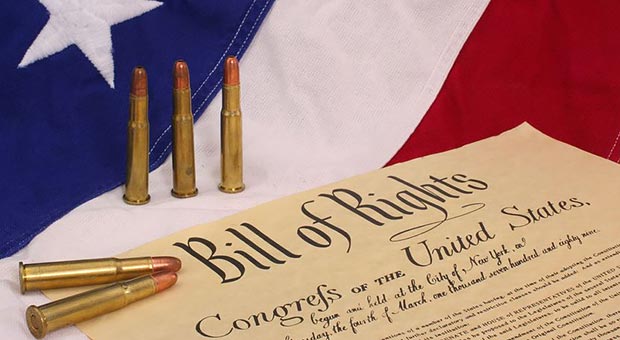
The Bill of Rights–the first ten amendments to the United States Constitution–was ratified in 1791.  This included the Second Amendment, which protects the right of American citizens to keep and bear arms.
In 1968, over 170 years later, Congress passed the “Gun Control Act”, which prohibits illegal aliens, felons, those diagnosed with mental illness, dishonorably discharged veterans, and other codified people from legally possessing or purchasing any firearms. Today, federal guns laws are enforced by the Bureau of Alcohol, Tobacco, Firearms, and Explosives (the ATF).    However, the ATF does not create laws, nor can it always enforce federal law in certain states.
It is often a slippery slope when it comes to which branch of government (federal, state, or local) defines the ultimate law when it comes to the possession of firearms, especially when traveling across state lines.  United, these states are not, particularly when it comes to matters of gun laws.  This makes for carrying firearms from one portion of the country to another a precarious and often indefinable matter.
To begin, there is no federal permit available (or required) for transportation of a firearm from state-to-state.  That sounds like a done and simple deal for someone who has a registered handgun in Nebraska and wants to bring it with him/her to Colorado on vacation.   In reality, doing so is easier said than done.
By verdict of Printz v.  United States in 1997, states are not legally obligated to enforce federal gun laws.  Additionally, some states have preemption, meaning the regulation of firearms is only governed by the laws of that particular state.  To complicate matters further, the local governments in some states are able to pass even more restrictive gun laws.  This is merely pointing out that local legislation can trump state and even federal regulation sometimes.
The main rules for using/owning a gun (while staying put) are essentially the same for travelling, and include:
  • Keeping your firearm unloaded and stored in a case or lock-box
  • Keeping ammunition separate and preferably in a locked vessel
  • Not carrying a gun onboard a plane – it must be stored, unloaded, in checked baggage, and the ammunition kept in a separate checked bag
  • Declaring that you have a firearm or ammunition when traveling across legally defined borders – honesty is definitely the best policy here
Local Regulations
If you plan to carry a gun across the US, you have to be ready and willing to comply with each state’s jurisdiction.  The Firearms Owners’ Protection Act (FOPA) promises to protect anyone carrying a firearm for lawful purposes from local restrictions.   However, as mentioned above, local laws may come into affect as soon as any firearm is “carried on or about a person, placed or loaded, or readily accessible in a vehicle”.  Be aware that many states will recognize FOPA statues only after you’ve been arrested to view your neglect as an affirmative defense.
If traveling by car or bus, the “Safe Passage Provision” basically protects a gun-owner from being put in jail if he or she is traveling through a place that has strict gun control (stricter than where he came from).   That is to say that he/she must be on his way to somewhere else when stopping to eat or refuel and then moving on to his intended destination.
For example, a competition shooter driving with a rifle on his way from Virginia to Maine could not be arrested and incarcerated in New Jersey because he was passing through.  If he decided to stay in New Jersey for a prolonged period of  time for some unknown reason then, yes, he could be prosecuted.
Carrying a concealed handgun across the United States has many diverse stipulations.  Residents of one particular state must get a license from the state to which they are traveling.  Or, on a broader scale, one may acquire a license from a state like Florida that allows nonresidents a permit to travel into approximately 28 other states with his/her concealed permit.
The majority of U.S.  states accept a “Shall-Issue” jurisdiction, which is when a person meets reasonable criteria for owning a gun.  In many cases, these individuals are allowed a license for a concealed weapon if they choose.  A “May-Issue” ensues when a state requires a permit, but one that is at the discretion of local authorities.  This type of stringent concealed-handgun law exists in California and New York, perhaps because of celebrity-stalkers and the need for extended personal-protection from actors, producers, etc.  Regardless, these states may enforce trespassing laws on individuals from other states with concealed weapons as hanging around too long and not just “passing through.”
Basically, if one is a registered, legal firearm-owner in his/her state, the best advice–if the plan is to travel across the United State–is to seek  an understanding of the laws of each state you will travel through.  A quick search on the Internet or even a call to a town’s Chamber of Commerce can facilitate your trip and ease your legal worries.
Remember, we still have our Bill of Rights.  Although some states have limitations, we still thankfully have the ability to travel freely.  And more importantly, we have the right to own our guns and use them for home protection if we choose.

Wednesday, March 19, 2014

How to Better Use Maps for Survival

BIG-mapIn a world where GPS systems and cell phone trackers make it easier to navigate, many people are lulled into a false sense of security. Unfortunately, when SHTF, computer and satellite assisted navigation technologies may not be available.
Learning how to use paper maps and a compass can make an enormous difference, and should be a part of every survival plan.
The Compass and How to Choose a Good One
Without a compass, you will find it very hard to use a map. The compass has been in use for many centuries, and was originally used to navigate small wooden ships. Later on it was also used for land navigation.
A compass has two important parts: the needle which spins and points to the North, and an outer ring which reveals direction in 360 degrees. On a good compass, the  magnetic arrow should move freely without binding in the case.
While smaller, light weight compasses may seem easier to carry, they can also easily give false readings because the needle does not have enough room to float and balance properly.
It is better to buy a good quality expensive compass than a cheaper one and have it fail when you need it most.
Choose a Good Map
To begin, your map should be an accurate representation of the area you are planning to be traveling in.
Some of the best maps are made by the US Government and are easy to obtain for free or low cost through the government’s catalog. There are also other map making companies, but their products cost more and have less usable information.
It is very important that your map is legible and durable. There should be no thick heavy folds, smudge marks, or tears in the material.
If the map or atlas does not come with water proof covering, you should get one for storage purposes.
Here are some important pieces of information that should be on every map you own:
  •     The Legend is a list of what each of the map symbols mean.
  •     Scale is the ratio of enlarging or reducing the size of a map. An example of this is one inch on the map is equal to 100 yards on the real landscape.
  •     The Compass Rose is a large arrow that shows you which part of the map is oriented to the North.
  •     Altitude and depression markings.  When looking at your map, you will notice circular lines. These lines denote height or depression of the landscape. The tighter or closer the lines, the steeper ascent or descent. The     farther apart the lines are, the less the steepness of the land.
How to Use a Map and Compass
To align the map to countryside you are working, you will need a compass to point out North in the region. Since compasses can be thrown off by hidden metals in the area, you should always try to compare compass readings to Sun position and other information available in the landscape.
Once the map and the compass are oriented, measure distance on the map from where you are standing to a location you wish to go to. Draw an imaginary straight line between these two points. Pay attention to altitude markings along your projected path. If the path looks too steep, make a second imaginary line, or set of lines to go around the area.
Next, take a ruler and measure the length of each line that defines your path. Add up all the lines, and then multiply the number of inches by the scale on the map. This will give you the estimated geographic distance between the two points.
When trying to navigate, you may need to alter course based on the terrain.
For example, if you are going  over a mountain try to cross in a low valley or walk the ridge to a point where your down path will not be too steep. Once down the mountain, set your course again on the flattest land you can find. Also try to stay out of deep valleys. They sometimes end up as a box canyon and you will waste valuable time.
Be a Good Judge of Time, Distance, and Altitude
mapWhen land navigating, be a good judge of time.
Know how to tell time without using a watch. Being able to read the position of the Sun in the sky will give you an idea of the time, and also help you stay on course. If you misjudge the distance, it might be too far to make it with the provision you have on hand.  It is better to overestimate the time and distance and get there sooner than to underestimate the time and distance and run into problems.
People acquainted with GPS systems truly do not realize the risks associated with lack of information about altitudes.
If the altitude above sea level is higher than you are accustomed to, breathing problems can occur. Low oxygen can make your thinking very slow, which can increase your risk of falls or making bad decisions. It can also cause unconsciousness, headaches, and finally death.
Keep a Notebook of All Map Information
Always keep a notebook log a complete record of the trip. Enter into it all course bearings, time and distance information, altitude, and weather conditions of the trip. If you missed any of your end points, there is written record of your information on what might have caused the problem.
The more you use and practice your map and compass skills the better you will get with them.  You can start off with short trips in known areas, and gradually work your way up to more complicated landscapes.
Before you know it, you will find yourself wondering why any person would be happy with the lack of good quality information found on modern GPS systems.

Monday, March 17, 2014

Survival Medicine Handbook: Review

Survival Medicine HandbookPreparedness folk spend a lot of time worrying about the beans and the bullets, but few consider the importance of the bandages as well. Few medical personnel take the time and effort to put together strategies for when modern medicine is not available.  This circumstance can be caused by natural catastrophes (hurricanes, tornadoes) or man-made disasters (certain wildfires, pandemics, civil unrest).  It’s true that the chance of any one of these calamities might be small.  It should be pointed out, however, that your chances of experiencing some type of disaster situation during your lifetime might not be so small.  Therefore, you should prepare medically as much as you prepare for the common defense or food shortages.

Introducing the authors of The Survival Medicine Handbook

Joseph Alton, M.D. and Amy Alton, A.R.N.P. are a physician and nurse practitioner team also known to the preparedness community as “Dr. Bones and Nurse Amy”.  Unlike most medical professionals, they write about scenarios on their website (www.doomandbloom.net) in which you might be the end of the line with regards to your family’s health. Also unlike most medical professionals, they are proponents of integrative medicine.  Integrative medicine is the combination of conventional and natural methods of healing; The Altons believe that you should be able to use all the tools in the medical woodshed in times of trouble.

As such, they have published The Survival Medicine Handbook, now in its second edition.  The book takes the non-medical professional through all the likely issues they will encounter when the ambulance or rescue helicopter is not on its way.  Written in plain English, the book discusses scores of topics, making the case for medical preparedness in a way that few books have. The current edition is very comprehensive, with almost 600 pages of information that will help you keep it together, even if everything falls apart. Topics include all kinds of injuries, infections, and chronic medical illnesses.  The authors also talk about how to obtain and when and how to use different medications, like antibiotics, in detail.

The Survival Medicine Handbook is a useful reference for any survival or homesteading library.  With this book in your possession, you can have a head start in any disaster.  Make sure that those bumps in the road won’t be the END of the road.

Friday, March 14, 2014

Don’t Worry – The Inflation You See Is Just Your Imagination...

If you believe that there is high inflation in the United States, you are just imagining things.  That is the message that the U.S. government and the Federal Reserve would have us to believe.  You might have noticed that the government announced on Wednesday that the cost of living increase for Social Security beneficiaries will only be 1.5 percent next year.  This is one of the smallest cost of living increases that we have ever seen.  The federal government is able to get away with this because the official numbers say that there is hardly any inflation in the U.S. right now.  Of course anyone that shops for groceries or that pays bills regularly knows what a load of nonsense the official inflation rate is.  The U.S. government has changed the way that inflation is calculated numerous times since 1978, and each time it has been changed the goal has been to make inflation appear to be even lower.  According to John Williams of shadowstats.com, if the inflation rate was still calculated the same way that it was back when Jimmy Carter was president, the official rate of inflation would be somewhere between 8 and 10 percent today.  But if the mainstream news actually reported such a number, everyone would be screaming and yelling about getting inflation under control.  Instead, the super low number that gets put out to the public makes it look like the Federal Reserve has plenty of room to do even more reckless money printing.  It is a giant scam, but most Americans are falling for it.
Meanwhile, the prices of the things that most Americans buy on a regular basis just keep going up.  The following are just a few examples of price inflation that we have seen lately...
-McDonald's has killed the dollar menu because it is becoming impossible to "make any money selling burgers for $1".
But don't worry - the government says that the inflation you see is just your imagination.
-Amazon.com has raised the minimum order size required for free shipping from $25 to $35.
But don't worry - you can afford to order more stuff thanks to the great new job that you got during this "economic recovery".
-It is being projected that those using natural gas to heat their homes will see their heating costs rise by 13 percent this winter.
But don't worry - "global warming" should kick in to high gear any day now.
-The price of chocolate has gone up by 45 percent since 2007, and it is being projected that it will now be increasing at an even faster pace.
But don't worry - eating chocolate is bad for you anyway.
-Thanks to Obamacare, the health insurance premiums of many American families are absolutely skyrocketing.  As I wrote about the other day, one family down in Texas just got a letter informing them that their health insurance premiums are going up by 539 percent.
But don't worry - this is just "health care reform" in action.
Meanwhile, things just continue to get tougher for middle class American families.  Household incomes have actually been declining for five years in a row and total consumer credit has risen by a whopping22 percent over the past three years.
The quality of our jobs continues to go down and our paychecks are not keeping up with inflation.  In fact, 40 percent of all U.S. workers are now making less than what a full-time minimum wage worker made back in 1968 after you account for inflation.
So what do the "authorities" say that the solution to our problems is?
They want even more inflation of course.  According to CNBC, many Federal Reserve officials (including Janet Yellen) believe that what the U.S. economy really needs is a lot more inflation...
Inflation is widely reviled as a kind of tax on modern life, but as Federal Reserve policy makers prepare to meet this week, there is growing concern inside and outside the Fed that inflation is not rising fast enough.
Some economists say more inflation is just what the American economy needs to escape from a half-decade of sluggish growth and high unemployment.
The Fed has worked for decades to suppress inflation, but economists, including Janet Yellen, President Obama's nominee to lead the Fed starting next year, have long argued that a little inflation is particularly valuable when the economy is weak. Rising prices help companies increase profits; rising wages help borrowers repay debts. Inflation also encourages people and businesses to borrow money and spend it more quickly.
The rest of that article goes on and on about how wonderful inflation is for an economy and about how the U.S. economy desperately needs some more of it.
Well, if that was actually true, then the Weimar Republic should have had one of the best economies in the history of mankind.
But this inevitably happens when a nation starts producing fiat currency that is backed by absolutely nothing.  There is always a temptation to just print a little bit more.
In the end, we are going to be destroyed by our own foolishness.  We have the de facto reserve currency of the planet, and the rest of the world has trusted it for decades.  But now we are systematically destroying our currency, and the rest of the globe is looking on in horror.
If you want to see a very good example of the impact that inflation has had on our economy in recent years, just check out this amazing chart which shows what the Federal Reserve's reckless policies have done to the prices of commodities.
Ultimately, the U.S. dollar will be destroyed, and we will have done it to ourselves.
Many people are attempting to protect themselves against this inevitability by putting a lot of their money into hard assets such as gold and silver, but before you do that you might want to make sure that you don't have a vengeful spouse that will toss it all into a dumpster someday.  The following is from a recent New York Post article...
A Colorado man was so angry at his ex-wife for divorcing him that he had the couple’s life savings of $500,000 converted to gold — then tossed it in a dumpster so she couldn’t have any of it, theColorado Springs Gazette reports.
In June, Earl Ray Jones, 52, of Divide, Colorado, was ordered by a judge to pay $3,000 a month to the woman he’d been married to for 25 years, so he pillaged the couple’s retirement account and had it converted into 22 pounds worth of gold and silver bars,  the paper reports.
Jones claims he then tossed the modern-day treasure into a dumpster behind a motel, where he had been living temporarily, later telling the judge he had no money to give his ex-wife, according to the paper.
Did that story make you smile?  It sure did the trick for me.
But that story is also a picture of what the Federal Reserve is doing with our dollar.
Our currency has been used for decades by almost everyone else around the planet.  In fact, more U.S. dollars are used outside of our country than inside of it.
But now the Federal Reserve is systematically trashing the dollar and the rest of the globe is starting to lose faith in it.
Instead of realizing their mistakes, Fed officials say that we need to create even more inflation and they just keep on wildly printing more money.
In the end, we will all pay a great price for their foolishness.

Thursday, March 13, 2014

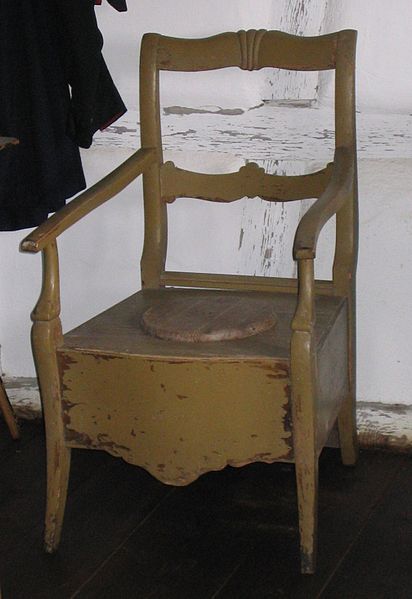
Chamber pots, potty chairs and “Night waste”

Only a hundred years ago, our ancestors handled having to use the toilet during the night very differently than we do today.  Now, we get up, go to the bathroom, use and flush.
Not so in earlier times.  For our ancestors, there were a multitude of methods to take care of waste when one didn’t want to trot out to the outhouse in the middle of a snowy, freezing night.  Here are some of the practical solutions:
A night table: (to hide the chamber pot in and reduce it’s smell)   Image
All of these, however, needed emptying in the morning.  Many were emptied into privies or out houses, which are different words for the same facility.  Some were, and still are, emptied into the sewer directly.  In older times, it was not uncommon to hear the term “gardy-loo!” in cities.  This term is a bastardized version of the french “gardez-l’eau” or watch out for the water, as the chamber maid tossed the smelly contents into the street.
All of these historic thoughts on how people handled poo ask the question, should the water go out indefinitely, are you prepared to handle waste?
For myself and my family, well, we’ve got a chamber pot.  It’s a 5 gallon bucket with a toilet seat on it.  Easily built and hauls the waste without much slop.  We’ve also got a corner of our property that we could put a privy on AND an old 6 mile long culvert to connect to.
Do you have an outhouse?  A privy?  A small shed that you could turn into one?  In a similar vein, do you have a way to handle your family’s nighttime needs?  How would you work this practical problem out?

Wednesday, March 12, 2014

ARE YOU READY?

There is an unfortunate reality that the complexity of modern society leaves us vulnerable to disruptions of our food, power, water, medical, and communications systems. These disruptions can occur quickly and from a variety of threats, many of which are difficult to imagine given the tranquility we have come to enjoy living in this country. Logic would suggest that our governments would be getting better assisting citizens during difficult times but tighter local, state, and national budgets limit what can be done. Most of us have come to resent the bureaucracy that is synonymous with government resulting in some critical decisions being made a glacial pace.
When a crisis does occur, common management theories describe the process that assess the threats, evaluate alternatives, and then implement plans that attempt to minimize the threats but when you are dealing with people that are scared, hurt, or threatened, logic and procedures do not always win out. Our families safety is instinctual but reading many articles that discuss emergency preparedness there is the assumption that we are starting from a common set of circumstances. The truth is each emergency has a number of variables that need to be considered before we can create and implement a plan but creating a general classification is necessary to start to build a plan.
There are two primary strategies and two primary environments, bugging in or out and rural or urban location. Each of these four options have a different advantages and threats so logically each prepper can design a strategy based upon your location or objectives

Live Ready Emergency Matrix

Bug-In
Bug-Out
Urban LocationPriority: Security-Create hidden storage locations
-Locks, deadbolts
-Cover windows-Water collection, purificationKey Item: Gun / taser /mace

Wild Card: Fresh water
Priority: Mobility- 3 Alternative destinations- Bug out bag- Water
-Fast departure
Key Item: Dirt bike-motorcycle
Wild Card: Martial Law
Rural LocationPriority: Preserve Advantages-Secure property / boundaries-Store food/ammo/water/ fuel in varied locations- Mask activities such as sounds and smells of habitat.
Key Item: Solar power/batteries
Wild Card: Electricity
Priority: Communications-Develop network of resources.-Find hot spots, safe spots-Travel back roads
-UV water purification system

Key Item: Bug-out-Bag

Wild Card: Weather
This model shows that each of the four choices can serve as the baseline for strategies around food, water, medical needs, and communications. Breaking down each option clearly shows how unique advantages can be created.
Urban Location-Bugging-InIn 1990, 40% of the world lived in urban areas but that number grew to 50% in 2010. Estimates suggest that by 2030 60% of the global population will live in a city. The reasons are obvious, better hospitals, less travel, professional sports teams but what about when a crisis happens and all those people compete for resources? Many would argue that being in a city during a crisis is the worst place to be but for many people they need to stay where they are and make do. News events have shown how dangerous scared people can be especially in large numbers. If you are going to bug-in in an urban location you need to have a plan to secure your items and protect yourself. The key tactics for urban-bugging in include:
-Dead bolts on all doors and windows
-Surveillance cameras if possible
-Window coverings
-Secret locations within property to secure supplies
-Map out neighborhood to identify water, fuel, food, and secondary location if needed.
-Solar lighting
-Freeze dried food
-Gun / taser / mace
Cities were designed for convenience not self-sufficiency. Everything in a city is brought in when it is needed; there is little long-term storage. Water is processed and dependent upon electricity so finding secondary sources or water or purifying unconventional sources may become necessary. It is important to remember that after only a few days a city can become lawless and then it will become militarized. Many people will attempt to leave so if you are going to ride out the storm you want to be invisible to those around you if possible. Looting, traffic jams, violence, and darkness must be addressed so securing your location is the priority that supports all other strategies.
Urban Location-Bugging Out
As stated a city in crisis is not a safe place to be but you will not be the only one with the desire to get out as quickly as possible. Many cities offer a variety of exits but as seen with hurricane Katrina road and bridge infrastructure can be quickly compromised reducing your options. In this scenario the priorities change to the following:
-Mobility
-Careful packing of what you are going to take
-Your destination, make sure you have pre-positioned supplies
-Maps . GPS/ lighting
When you are escaping to your next location you need to stay focused on the fact that the majority of people around you will not be prepared and therefore not civil or logical. Again, people in crisis are dangerous so you movements need to be carefully executed. While this is not a suggestion that everyone can take advantage of a motorcycle, ideally a dirt bike or four-wheelers are great option to take you that first 20 miles out of a city. Motorcycles are smaller than a car and can be stored in many places. Fuel economy is much better than most cars and bikes can be configured with saddlebags to accommodate nominal supplies. Dirt bikes are also not restricted to paved roads which will help you separate from the clogged interstates where even a simple traffic accident can snarl traffic for miles. Again planning is the key to success, as you need a destination and a plan. If martial law is implemented your movements will be highly limited so evaluate scenarios as to when your mobility will be best and then commit to the destination.
Rural Location-Bugging In
As someone who was raised in New England I am most comfortable with my rural location and bugging in. Water is usually plentiful and early in a crisis you will have the luxury of not trying to move allowing you to focus on securing the property and assessing the situation. As with any bugging in scenario security is critical as within a few days those that have not planned will begin to seek those that have prepared.
Key Priority:
-Secure property, make it appear vacant
-Bury resources in varied locations
-No noise, no gas generators
-Limit smells especially when cooking
-Limit lights on at night, black out windows
-Don’t secure all items in one location
-Have decoy stashes of small quantities of food or ammo
-If you have the skill set up trip wires or other boundary deterrents
If you have visitors you can either fight or mislead those that try to take your supplies. If your plan on fighting, please remember that those coming for you will likely fight back and as time goes on the survival of the fittest means your adversaries will be formidable. If you choose to avoid violence then deception is your best strategy and your behaviors need to mask the supplies you have at all times. No noise, smell, light, or unsecured assets. A good solar generator is a must as it is silent and can also serve as a battery unit to store energy. While there will be a comfort in staying in familiar surroundings few homes were build for these types of scenarios. Lots of windows, poor quality doors, and conventional construction materials will do little when someone has a shotgun, fire, or equipment to smoke you out of your property.
Rural Location-Bugging Out
In the final scenario you have the benefit of fewer people so the risk of civil unrest may be easier to avoid however distance between resources may be significant. If you have fuel or other desirable equipment and you are on the move you risk exposing your advantages to a larger number of people. Movement may be necessary however pre-staging supplies in different locations will give you the advantage of choices for your destination. Key priority: Communications
-Move only to areas that have been pre-cleared of threats
-Use routes that minimize exposure to main roads / other people
-Minimize supplies you take from location to location if possible
-Choose your network of partners carefully and confirm they are equally committed to the partnership
-Water and fuel need to be with you at all times
-Well stocked bug-out-bag with medical supplies
Being mobile is both an advantage and a risk during an emergency. If you are familiar with the territory it is a major benefit as you can navigate around unforeseen obstacles and inventory resources. A reliable vehicle, adequate fuel, and world-class bug-out-bag are a must. Regional weather and seasons may play a major part in your decision to move. If you live in a cold weather climate your source of heat is critical as a campfire is a calling card you may not want. Don’t forget protective items as you will be required to potentially defend yourself at anytime should someone want what you have.