Why?

This blog is to help you in preparing for an emergency. It also contains other information that you might find spiritually up-lifting. This is not an official website of "The Church of Jesus Christ of Latter-day Saints". This site is maintained by Barry McCann (barry@mail.com)

Monday, March 4, 2019

California sisters, 8 and 5, survived 44-hour ordeal by drinking fresh water from Huckleberry leaves


Two young sisters who survived for 44 hours in the wilderness of Northern Californiabefore they were found alive on Sunday did so by using basic survival skills they learned at their local 4-H club.
Carolina Carrico, 5 and Leia Carrico, 8, were discovered around 10:30 a.m. by two firefighters who were able to follow their tracks and locate them, Humboldt County Sheriff William Honsal told reporters.
"This is an absolute miracle," he said. "This is rugged territory, this is an extreme environment. How they were out there for 44 hours is pretty amazing."
Leia and Caroline are seen in this undated photo. The Humboldt County Sheriff’s Office said the two girls walked off into the wooded area nearby their home before being rescued on Sunday.
Leia and Caroline are seen in this undated photo. The Humboldt County Sheriff’s Office said the two girls walked off into the wooded area nearby their home before being rescued on Sunday. (Humboldt County Sheriff’s Office)
The girls were found uninjured and "in good spirits" roughly 1.4 miles south of their home in Benbow, located about 70 miles south of Eureka in the northwest part of the state.

Officials were able to locate the girls after Delbert Chumley and Abram Hill from the Piercy Volunteer Fire Department initially found their boot prints at 8:30 a.m. After following the tracks, the responders reached an area near Richardson Grove State Park and called out to the girls, who responded.
"The girls were located huddled together under a bush," the sheriff's office said. "The sisters were evaluated by medical personnel for dehydration and given water and warm, dry clothing."
The sisters told officials they were following a deer trail when they became lost.
"The two decided to stay put, drinking fresh water from Huckleberry leaves," officials said.
Leia and Caroline are seen in this undated photo.. The Humboldt County Sheriff’s Office said the two girls were reported missing on Friday.
Leia and Caroline are seen in this undated photo.. The Humboldt County Sheriff’s Office said the two girls were reported missing on Friday. (Humboldt County Sheriff's Office)
The sisters were reunited with family shortly after being located, and could be seen being embraced in photos released by the sheriff's office.
Caroline and Leia Carrico are reunited with family members in this photo released by the Humboldt County Sheriff's Office.
Caroline and Leia Carrico are reunited with family members in this photo released by the Humboldt County Sheriff's Office. (Humboldt County Sheriff's Office)
Another photo of one of the girls posted by the sheriff's office and already being widely shared on social media shows Caroline Carrico wearing pink rubber boots, dirty jeans, a long pink shirt and a woolen cap.
Caroline Carrico is assessed by search crews after being lost in the Northern California wilderness for 44 hours.
Caroline Carrico is assessed by search crews after being lost in the Northern California wilderness for 44 hours.(Humboldt County Sheriff's Office)
She is standing while a firefighter kneels down and talks to her.
After being assessed by first responders, the girls were taken to the hospital for observation. Their mother shared a photo of the two having pizza in a hospital bed.
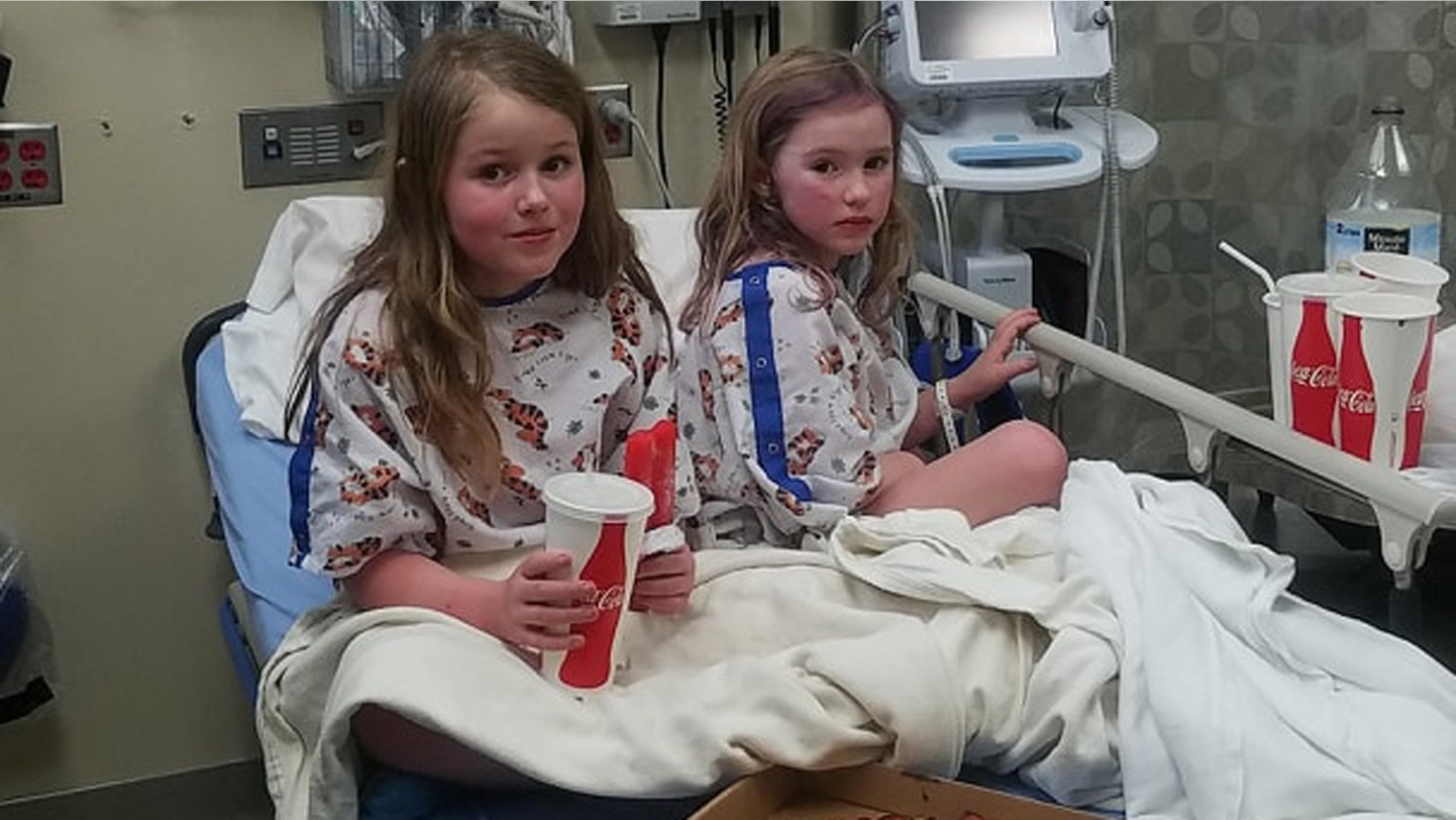
Leia and Caroline Carrico can be seen eating pizza in the hospital after being rescued after spending 44 hours lost in the Northern California wilderness.
Leia and Caroline Carrico can be seen eating pizza in the hospital after being rescued after spending 44 hours lost in the Northern California wilderness. (Misty Carrico)
More than 250 personnel from across the state responded to take part in the search for the girls, who were reported missing at 6 p.m. on Friday. The girl's mother, Misty Carrico, had noticed the two were gone roughly 30 minutes after they asked to go for a walk and were told no.
Delbert Chumley (right center) and Abram Hill (left center) from Piercy Volunteer Fire found Leia and Caroline 1.4 miles southeast of their Benbow home. They are seen in this photo released Sunday with Sgt. Kerry Ireland (left) and Sheriff William Honsal (right).
Delbert Chumley (right center) and Abram Hill (left center) from Piercy Volunteer Fire found Leia and Caroline 1.4 miles southeast of their Benbow home. They are seen in this photo released Sunday with Sgt. Kerry Ireland (left) and Sheriff William Honsal (right). (Humboldt County Sheriff's Office)
Lt. Mike Fridley said during a news conference Saturday that rescuers were hopeful about finding the girls after granola bar wrappers were found in the woods that matched the brand in the Carrico's residence that their mother said were recently purchased.
"So the wrappers showed us a direction from where they started to where the wrappers ended," Fridley said.
Fridley said Sunday he was the one who got to call the girls' mother and tell them her daughters were alive.
"She melted on the phone," he said.

Friday, March 1, 2019

16+ Tools For Your Car Survival Kit


Portable Device Generator – Learn How To Build Your Own Energy Generator! 

By and large, I’ve driven older vehicles, as I could never see sticking myself with the huge payments associated with most cars. But just because they were older cars, doesn’t mean that they weren’t good cars. I’ve always tried to keep my cars in good mechanical shape and made sure they were ready to get me through those everyday problems.
But being ready to get through these problems entailed much more than just having a sound engine; it meant having the right things in the car to deal with a wide variety of different situations. We are a highly mobile society today, taking our cars everywhere. So preparing your car to deal with a range of potential problems also means that you’re ready to deal with those problems as well.
This has been how I’ve operated for over four decades now. In doing so, I’ve not only been prepared to help myself through a wide range of problems, but have also been able to help many others who have found themselves in trouble. Whether it was in being the first to arrive at the scene of an accident or finding someone whose car ran off the road in an ice storm, I’ve helped enough people out of trouble, that I’ve often wondered why I didn’t get preprinted invoices to use.

The Vehicle Itself

I always start with the vehicle itself. As I already mentioned, it’s important to have your vehicle mechanically sound. You’re not going to be ready to help yourself out, let alone anyone else, if your vehicle is broken-down beside the road. Granted, there are things which can happen that can’t be foreseen; but if it can be foreseen and you didn’t see it, you’re not helping yourself.
What does this mean in practical terms?
  • Change your oil regularly – that does more to maintain your engine’s health than anything
  • Check fluids regularly
  • Check belts and hoses regularly – there are a lot of breakdowns due to belts and hoses wearing out
  • Check tires regularly and fill as necessary – tire air pressure changes with the season, so never assume that it’s okay. Don’t forget the spare either
  • All lights are working
  • Wiper blades aren’t worn out
  • Any red warning lights on the dash have been checked out and necessary repairs made
That’s really not a long list, so it’s not all that hard to keep up with, even on an older vehicle. If you can, you will eliminate a lot of the problems that people end up stuck on the side of the road for; not all of them, but a lot of them.
You may want to make some slight modifications to your vehicle as well, such as adding lights, so that you can see better in an emergency situation. I’ve used a variety of lights at different times; but always make sure that I have at least one powerful spotlight I can use.
Another modification to consider is making sure that you have a good connection point for jumper cables. Some newer cars have the battery hidden. In those cases there are normally contacts you can use, but not all models have them. Make sure you have readily accessible points for jump-starting your car or for jump starting other people’s cars. I’ve even gone as far as running permanent cable to the other end of the car for this purpose.
It’s a good idea to check your vehicle for towing points as well, both in the front and rear. Some cars are not easy to connect to for towing, while others have actual towing points installed. I’m not talking about the towing points used by a tow truck here, but used by a friendly passer-by to get you off the road and out of traffic, or that you would use to do that for someone else.
If your car doesn’t have good towing points, you can easily rectify that problem by attaching some U-bolts to the structure. Just drill holes though and bolt them on. That makes it much faster and easier to hook a tow strap or chain to your vehicle. Of course, if you have a trailer hitch, that can be used as well.

Emergency Vehicle Equipment

The next category of equipment to consider is emergency equipment for your vehicle itself. This is the equipment you need to have, in case of car trouble. Hopefully you’ll never have to use this for your own vehicle, if you are properly maintaining it. But you might end up using these items on other people’s vehicles as well, saving them from a catastrophic problem.
  • Basic tool set for repairs – metric socket set, metric wrenches, pliers, screwdrivers
  • Jack – I wouldn’t count on the scissors jack that comes with the vehicle, as they are hard to use and not very stable; rather, I carry a hydraulic one
  • Lug wrench – again, I don’t count on the one that comes with the vehicle, as it is hard to use, but rather a star wrench
  • Water – for an overheated engine
  • Hose repair – Duct tape and hose clamps works well for this
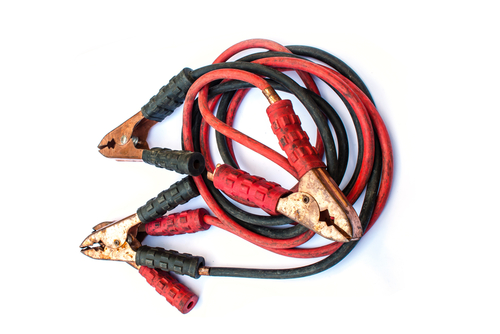
  • Jumper cables – good quality ones, the cheap ones aren’t good enough
  • Towing strap or chain – I prefer a nylon strap, but some people like chains better
  • Heavy-duty paper towels – to clean your hands
In addition to these items, it’s a good idea to keep some spare oil, power steering fluid, transmission fluid and brake fluid in your car. A lot of minor emergencies are nothing more than someone forgetting to check their fluids. Along with the battery, those should be the first thing to check.

Personnel Needs

Taking care of your vehicle is merely the starting point. If you take care of it, there’s much that your vehicle can do to take care of you. Today’s cars and trucks are designed with a lot of safety features installed, so that they can protect you in the case of an accident. But they can do more than that; they can act as an emergency shelter, should you need. People live in their cars all the time; and while it may not be a comfortable place to live, it can protect you from the elements in a pinch.
But you’ll want to have some personal equipment and supplies in the car, so that you can be at least somewhat comfortable, in the case of an emergency. If you end up in one of those situations I mentioned in the introduction to this article, you want to have the things you need to have, in order to take care of yourself.
To start with, make sure you have a good EDC bag with you. By “good,” I’m referring to one that is heavy on survival gear. My personal EDC bag is a combination EDC, survival kit and get home bag. Other than transportation, water and my pistol, it has everything I need, so that I can survive several days.
In addition to that EDC, your car should also have:
  • Blanket and pillow (lots of people forget the pillow)
  • A seasonally appropriate coat and hat
  • Good work gloves – by “good,” I mean durable. They can double to keep your hands warm
  • Potable water (drinkable)
  • Snacks – things that will last well, like granola bars, nuts and jerky
  • Head lamp with extra batteries
  • Bungee cords – useful for more than just tying down loads
  • First-aid kit – this needs to be a good trauma kit, with enough supplies to take care of major injuries and splint broken bones. Make sure you learn how to do things like a preliminary evaluation of a patient, how to stop bleeding, treat shock, properly use a tourniquet, and how to treat a sucking chest wound
  • Toilet paper – get stranded once, and you’ll be glad you have it
Don’t take this list as being totally complete. There may be things that you need to have, which I don’t mention, such as prescription drugs that you need for a chronic condition. We are each different, with different needs, so you have to make sure that you have what you might need, in the case of emergency, not just what I think I need.
It’s not hard to keep all of this, and even more, in the trunk of your car. I’ve kept all of this in my cars for decades and never had a problem being able to haul the groceries home from the store or go on a trip. It’s all a matter of packing it away well, so that space isn’t wasted.

Wednesday, February 20, 2019

Three Survival Items That Never Fail

Three Survival Items That Never Fail


We have all watched in horror as a piece of our trusted survival gear breaks. We have all watched attachments break, blades snap and even handles crack. It happens. Most of the time it happens on a camping trip with little risk. Thank God for that! Still, it has a serious affect when it happens.
Instantly, you are transported to a place and time where that piece of gear is all that separates you from disaster. It’s a terrifying thought. It calls into question the quality of your gear and how you handle and maintain it.
What survival items can you add to your setup that never fail? Well, there are plenty, but three come to mind. These three will not only stand up against survival they will also make the biggest impacts on a survival situation.

Bank Line

For a long time, the survival cordage space was dominated by paracord or 550 cord. There was no getting away from this stuff. It became the ultimate in survival cordage primarily for its tensile strength and the 5 smaller strands of cordage that were inside of each strand.
I don’t want you to think that there is an epidemic of paracord failures. That is not why I am bringing it up. There are other alternatives and when it comes to cordage, bank line is less bulky and weighs about half as much as paracord. Now, that should get you excited.
Bank line can be purchased with vary degrees of tensile strength. It’s a finer cordage than paracord but its very strong. Bank line takes up much less space than paracord and that space savings is exponential as you increase the amount of cordage you carry. You can grab a 100-foot spool of quality bank line for about $4 or less.
No matter the situation you face, a spool of quality bank line can make you shelter, catch your food and stand the test of the outdoors.

Ferro Rod

If you go overboard in a canoe, if you roll down a steep embankment, if you find yourself in the throes of some situation that separates you from your gear or treats your gear to some blunt force trauma, the ferro rod will be there.
Aside from a modern lighter or a piece of flint and your survival knife, the ferro rod is the most dependable and fast acting fire starter there is. If you are looking for a fire-starting companion that will not fail you, invest in a nice thick ferro rod. Don’t buy one of the thinner rods.These can break easily. buy a 1 high quality ferrorod that will last.
Aside from the fact that it will never fail to shoot sparks, even if it’s wet you can just dry it off, the ferro rod is also going to lastyou a very long time. If you have efficient tinder making skills and you understand how to build and sustain a fire, you might only need a few scrapes on that ferro rod to make it work.
Imagine how long a ferro rod will last you if you scrape it a few times for each fire. This is why the ferro rod is one survival item that will never fail you. You ask it to bring sparks and it will do that over and over again.

Bug Spray

Now, maybe you think I should bring you some impressive type of survival tool for the third item that will not fail you. A few come to mind. I could mention things like short handled axes or maybe something for creating shelter.
Its pretty clear that water, shelter and fire are the three most important parts of any survival situation. So, you might be asking yourself: why are you talking about bug spray?
Lots of survivalists get wrapped up in this idea of gear. They get to the point where they are wading in gear. However, things like sunscreen and bug spray are often left out. Could it be that these two items are just not exciting enough? They aren’t as cool as more modern survival gear?
Bug spray can make all the difference in a survival situation. If you are truly lost and trying to find your way out of the woods, you are going to need to be alert and awake. Sleeping in the woods, under a lean-to is challenging enough. Imagine getting bit by bugs all night, too! You can bet you will be groggy and tired come morning.
After a few days of hiking, without sleep, you will not be able to focus and getting out of the woods safely will become much harder.
Bug spray will never fail you. It is a powerful item that is light and easy to carry. There are many derivations of it but even some store-bought product will put an end to the gnats flying into your eyes or the biting mosquitos. Even bugs scurrying over you in the night can be brutal, if you aren’t used to it.
While the gear out today is impressive don’t forget about keeping the bugs and the sun at bay.

Conclusion

Of course, there are many other items that could be mentioned but I think these three offer up the benefits, the reliability  the sweeping power to affect survival on many levels.
For the most part a serious rifle for hunting is another piece of gear that is rarely going to fail you. Take into account that you could even build that weapon from a simple 80 percent lower and then you know how to fix it even if it breaks!
That’s the type of mentality we all need to focus on. Even if these great tools fail us, can we fix them?

Sunday, February 17, 2019

10 Defensive Shooting Tips That Could Save Your Life


Owning a gun is one thing, but knowing how to wield it is something else entirely. If you don’t know how to properly use your firearm in a self-defensive situation, not only do your chances of survival go down, but your chances of accidentally harming yourself or somebody else go up.
Fortunately, this can all be cured by just a little bit of regular practice on the shooting range where you can train with your defensive shooting skills and grow comfortable with your weapon of choice. The tips you are about to learn in this article apply regardless of what type of firearm you’re using.
Here are the top ten defensive shooting tips that could save your life:

1. Buy Enough Ammo

What good is a gun without ammo? It could serve you well as a club, but that’s about it. Therefore, the first defensive shooting tip is to actually buy enough ammo to practice your defensive shooting in the first place.  Since ammo is a little costly, you can get around this by making it a habit to buy just one or two boxes a week.  Your stockpile will grow steadily as a result.

2. Get A Proper Firing Grip

To hold a handgun correctly, you need to have both hands wrapped firmly around the grip of the gun with both of your thumbs forward. The fingers of your weak hand should be wrapped around the fingers of your firing hand. Hold the gun at eye level so you can peer down the sights.

3. Line Up Your Sights

Line up your front sight to your rear sight. You want the front sight to be aimed directly at the target.  Your eye should then be focused directly on the front sight. Your rear sight and your environment beyond the front sight should therefore be a little blurry.

4. Keep Both Eyes Open

A natural thing to do is to shut your non-dominant eye when peering down the sights of a firearm. This is a big mistake for two reasons: it causes extreme fatigue in your eye lids, and it shuts out half of your field of vision (so you may not be able to see an enemy approaching). Remedy this by keeping your front eye wide open and your second eye squinted but still open.

5. Keep Your Finger Indexed

One of the core rules of gun safety is to never place your finger on the trigger until you are ready to shoot. Keep your trigger finger indexed, meaning it’s resting on the frame of the handgun above the trigger guard.

6. Control Your Firing

Spraying and praying with guns is fun in video games, but it’s a horrible shooting technique in real life. It makes the gun uncontrollable, decreases the chance of you hitting your target, and increases your chance of accidentally hitting someone else who you don’t want to.
Rather, control your firing so that each individual shot is deliberate. If you want to practice double taps, that’s fine, but you should never fire any rounds that you didn’t intend to or that were out of your control. Avoid flinching as well (where you jerk the gun when it doesn’t fire). To practice not flinching, load some live rounds and dummy rounds into your magazine, but don’t know the order they are in. When the primer hits a dummy round and you flinch, you’ll need to correct that.

7. Reload Without Looking

Looking at your gun while fumbling around with a reload is a terrible thing to do. It removes your focus from the environment and it shows that you’re not a properly trained shooter. Therefore, put lots of practice into swapping out magazines and racking the slide to re-chamber the weapon. Keep your eyes focused on the environment around you as you eject the spent magazine, draw a fresh new one, insert it into the weapon, and rack the slide. Draw the gun in closer to you when you reload as well before re-assuming a natural and proper firing stance.

8. Know How To Shoot One Handed

While you should try to get a two handed grip if possible, some defensive scenarios may require you to only shoot one handed if you need to act quickly. Therefore, you should practice shooting one handed as well. When shooting one handed, keep your firing arm stretched out, while your non-firing hand should be clenched into a first and held to your torso. This way you know where your non-firing hand is and you don’t risk it being out in your field of fire.
 

9. Learn How To Clear Jams

It doesn’t matter if you purchase the most reliable pistol on the planet; experiencing a jam is a very real possibility. Just as you must practice reloading, so you must practice clearing jams as well so you can get back into the fight. Standard procedure with a jam is to firmly tap the magazine (most jams are caused by a not-fully inserted magazine) and then rack the slide to eject the failed round. If this fails, eject the existing magazine and load in a new one and rack it again. If this also fails to clear the weapon, you have a bigger problem on your hands.

10. Practice a Lot

The old saying goes that practice makes perfect, and practicing firing your weapon on the shooting range is not going to cut it. Make it a rule that you’ll practice on the shooting range a minimum of once per month, with a minimum of two hundred and fifty rounds fired each time.

Conclusion

Between owning two guns and not knowing how to use either of them or owning one gun and being a master at it, the second option is certainly more preferable if you’re serious about defending your life. Take the tips you have learned in this article seriously and apply them during your real life shooting range time.


Wednesday, February 13, 2019

The 8 Secret Essentials To Long-Term Food Storage

Our greatest priority in preparedness should be long-term food storage, simply because any catastrophic event will affect the supply chain and food will quickly become scarce.
But while food storage has significant value and provides us all with a level of security, there are some realities affecting food storage that we need to both understand and manage. If we fail to do so, we may find that our well-planned storage has failed on levels we hadn’t anticipated nor imagined.
What’s critical to understand is that most stated shelf-life statistics assume an ideal storage environment. The question we have to ask ourselves is: What is that environment and to what degree can we provide it? In that regard, the purpose of this article is not to list endless shelf-life possibilities, but to clearly identify the success factors and failure points that affect shelf life for any type of food.
The 8 “Secret Essentials”
  1. Temperature
  2. Humidity
  3. Oxygen
  4. Light
  5. Food type
  6. Packaging integrity
  7. Keeping away rodents and insects
  8. Rotation
1. Temperature
A fascinating discovery recently took place in the Antarctic that impacted how we view food storage. The base camp of Sir Robert Scott – the British man who died in 1912 while exploring the region — was discovered. One of the huts had canned foods and other food products that were still edible and free of bacteria after more than 100 years. The reason was largely due to the below-freezing temperatures that permeated the hut. The lesson is clear: The lower the temperature, the longer your food stores will last.  That’s why a basement or other root-cellar type of environment is preferable to an attic or a part of your home that is hotter or heated during the winter.
2. Humidity
Humidity is the most significant threat to long-term food-storage. It promotes both bacterial growth and mold growth. And it can happen in what you believe is the most hermetically sealed canisters you have. I had an experience where my wife needed significant amounts of sugar for Christmas cookies and desserts. Unfortunately, blizzards were dominating our area and travel was impossible. I laughed as I remembered that I had a five gallon bucket of sugar in our basement that had been sitting there for 10 years. The projected shelf life was 30 years and I figured, “No worries.” I was wrong. When we opened it, the smell of mildew was so over-powering that we couldn’t wait to get the can out the back door and onto the deck. Everything about the seal seemed intact, but moisture finds a way.
This is not only true for any package that could have moisture seepage, but also true for something as seemingly indestructible as a sealed, metal #10 can. Corrosion is common in moist environments and even the best metal in a #10 can succumb to corrosion in high levels of moisture.
Some companies enclose a packet of moisture absorbing crystals inside, but these are mostly designed to remove any residual moisture in the canned or packaged product. The point is, don’t store your long-term food-stores in a moist or wet environment. If your basement has that tendency, you might want to find an alternative storage location that still provides some level of low to average temperatures without excess humidity.
3. Oxygen
Image source: Couponfrenzymom.com
It’s ironic, but a molecule that all animals depend on for life on Earth is one of the most corrosive and destructive elements in the universe. While we breath oxygen deeply it both compromises and corrodes our long-term food storage. Some long-term food storage companies actually evacuate all oxygen from their canned or sealed products, and some inject nitrogen gas to fill the void and prevent oxygen from entering.
If you have purchased a hermetically sealed package such as a #10 can or a foil wrapped grain package with sufficient thickness or “mils” for the foil, you probably will avoid this oxygen problem. Many home-canned or cured meats may not fare as well. You realistically can’t remove oxygen from your living environment, but properly packaged long-term products will strive to reduce or eliminate oxygen to prevent it from compromising your food stores.
4. Light
When we talk about light, we’re talking about sunlight. Sunlight deteriorates food products quickly due to the ultra-violet or UV light that dominates sunlight. It’s one of the reasons beer bottles are usually bottled in brown glass to reduce and diffuse the effects of UV light. This typically isn’t a problem for many long-term food stores, but if you preserve your own foods, whether they be fruits or vegetables, you’re probably using clear, glass jars. Keep them out of the light, especially sunlight.
5. Food type
Anyone with any experience with home-canning and food preservation will tell you that certain foods lend themselves to preservation better than others. Typically, acidic foods like tomatoes and citrus fruits will preserve better given the fact that their natural acids retard bacterial growth.
Of equal consideration are foods that are naturally dry or dried such as pastas, whole grains, beans and grains like rice and quinoa or amaranth. What’s critical again is to seal out humidity and in the case of some grains – insects.
Meats, fresh fish, and other proteins like poultry are the most problematic when it comes to long-term food storage. Unless they are salted and essentially desiccated of all moisture, their shelf life tends to be short and variable. On the other hand, a jar of honey discovered in an ancient Egyptian tomb after 3,000 years was found to be both bacteria-free and edible as if it was harvested yesterday. Food type matters.
Once again, the standard rules related to temperature, humidity, light and oxygen apply to any food type.
6. Packaging integrity
Think about this whenever you consider any long-term food purchase. What does the manufacturer have to say about the packaging?
  • Are they hermetically sealed, meaning that no oxygen can enter?
  • Has any oxygen been vacuumed from the package?
  • Is there a moisture absorber or some type of crystals to absorb any residual moisture?
  • What is the material used to package the product? Metal? (What kind?) Plastic? “How thick?” Foil? (How many mils or relative thickness?)
  • Other features or benefits?
The premium suppliers will provide significant information with regards to packaging details, projected shelf-life and the usual advice about storage and temperatures. They’ll also answer your questions. The key is to make sure you’re purchasing a quality product in a quality package so you can do your best to maintain a healthy and viable food-storage plan.
7. Keeping away rodents and insects
It would seem that a sound and robust packaging solution would prevent rodents and insects from compromising your food storage. That’s what I thought until I found that some mice had chewed through a thick plastic box to later chew through a very thick layer of foil surrounding some whole grain wheat. Once they had accessed the wheat, their population exploded and then the ants joined the party. Shame on me. I had not paid much attention to this storage area and only did so when the mouse problem in the basement started to show up in the kitchen.
The fact of the matter is that mice can’t chew through metal and can’t chew glass, either. But don’t assume for a minute that a starving field mouse won’t find his way through plastic or foil. Think twice about what and where you store and once again, packaging integrity is key to keeping these pests away. Of course, mousetraps help, too.
8. Rotation
We’ve all heard it many times: “Eat what you store and store what you eat.”  And how many of us really do that? It’s hard when we have food storage products touting a shelf life of 10 to 20 years. Our tendency is to tuck them away and know they’re available if and when catastrophe happens. And that’s a problem. There are numerous benefits to the “eat what you store and store what you eat” philosophy. Here are a few:
  1. It forces us to take stock and inspect our food stores. Do I have a moisture problem? Are there any rodents or insects in evidence? Are any of the cans or other containers compromised? And maybe most importantly a simple reminder of: “What exactly do I have down here?”
  2. It teaches us how to cook this stuff. I remember whipping up some tacos with some textured vegetable protein (TVP) with a taco flavor. It was horrible. I didn’t like it, my kids didn’t like it, and my wife hated it. I was ready to throw the can away until I talked to a friend. He suggested I try it as an ingredient with some dehydrated vegetables and some seasonings. He was right, and it was better.
  3. You might find out you love some of this stuff. My kids love Mac and Cheese and I’m a bit partial to it, too. I grabbed a can of elbow macaroni and another can of cheese powder and whipped some up. It was great! And way cheaper than any boxed macaroni at the grocery store, including the store brands. This was actually a pivotal point for me, as it related to our long-term food stores and the whole “eat what you store” idea. What else was down there that sounded good for someday that would actually be great tomorrow?